Forex CRM with Client Portal: What Brokers Should Look For in 2026
Forex CRM with Client Portal: What Brokers Should Look For in 2026
Running a Forex brokerage requires far more than managing client records. From the moment a trader registers, they interact with multiple operational processes including onboarding, KYC, trading account creation, deposits and withdrawals, platform access and ongoing account management.
For this reason, a modern Forex CRM with Client Portal should not be treated as two separate pieces of software. The CRM is where brokerage teams manage the client relationship and operational workflows, while the Client Portal — often called the Client Area or Trader’s Room — is where the client interacts with many of those same processes.
When both environments operate on the same connected infrastructure, information can move between the trader and the brokerage without employees constantly transferring data between systems.
This article explains how a Forex CRM and Client Portal work together, which capabilities brokers should evaluate, and why the architecture behind the platform becomes increasingly important as a brokerage grows.
What Is a Forex CRM with Client Portal?
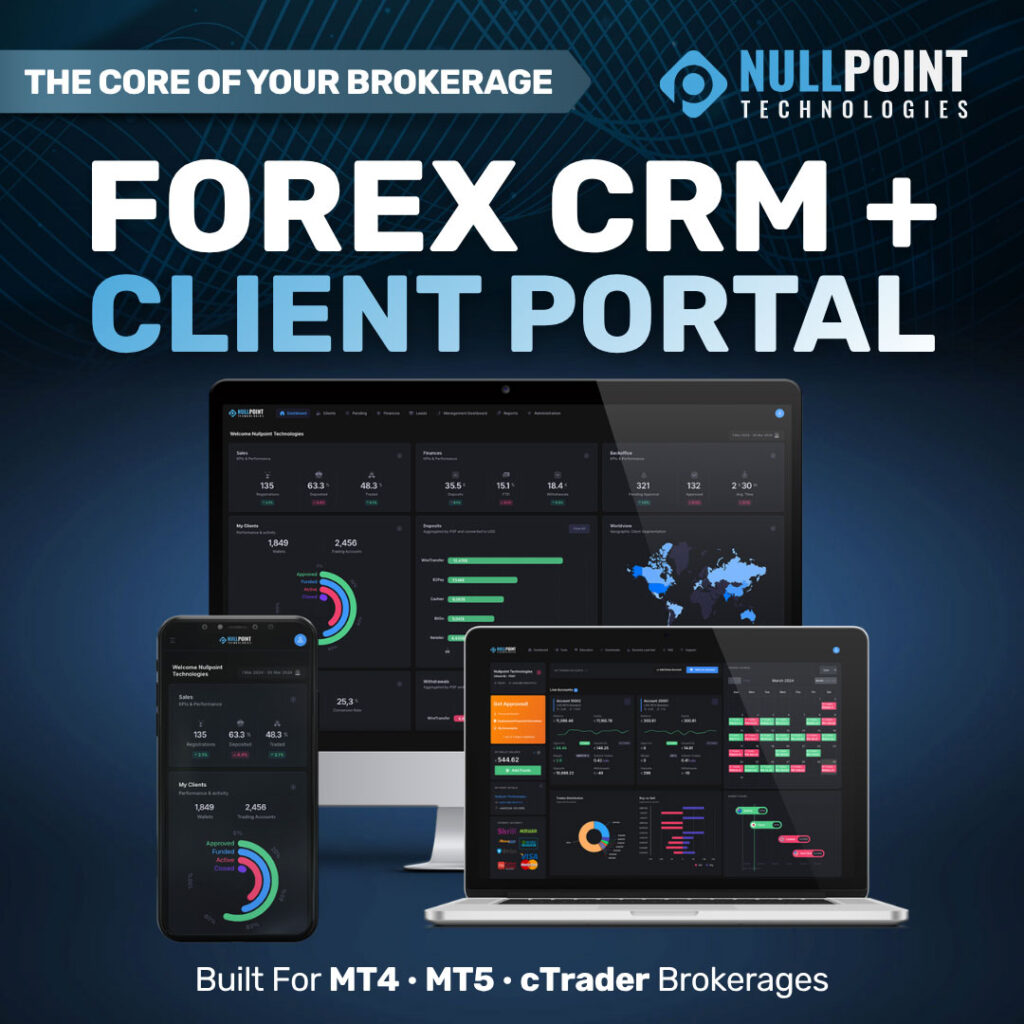
A Forex CRM with Client Portal combines the brokerage’s internal client management and back-office environment with a secure interface where traders can manage their relationship with the broker.
The Forex CRM is primarily used by brokerage employees. Sales, retention, compliance, payments and operational teams can use it to manage clients, monitor activity, review requests and coordinate workflows.
The Client Portal is the client-facing side of that infrastructure. Depending on the brokerage’s configuration, traders may use it to complete registration and verification, create trading accounts, deposit or withdraw funds, access trading platforms, update personal information and manage other aspects of their account.
The important distinction is that these components should not operate as isolated systems.
When a trader completes an action through the Client Portal, the relevant information should become available to the appropriate brokerage workflow. Likewise, changes made internally should be reflected appropriately within the client’s environment.
For a broader explanation of the underlying technology, see our guide to what a Forex CRM is.
Why the Client Portal Matters as Much as the CRM
Brokerages naturally spend considerable time evaluating the administrative capabilities of a CRM. However, the Client Portal deserves equal attention because it is one of the parts of the brokerage technology stack that traders interact with most frequently.
A prospective client may first encounter it during registration. Existing clients may return whenever they need to open an account, fund it, request a withdrawal, complete verification or manage their profile.
Poorly designed client journeys can therefore create friction precisely where the brokerage wants the opposite.
A well-designed Forex CRM Client Area should make common actions easy to understand while keeping the underlying operational processes connected to the brokerage’s internal systems.
This is why the Client Portal should not be evaluated purely on appearance. User experience matters, but so do workflow automation, trading platform connectivity, payments, KYC, security and the quality of the integration with the CRM itself.
You can explore these capabilities in more detail on the Nullpoint Forex CRM & Client Area.
Registration and Onboarding Should Be One Connected Journey
The relationship between the CRM and Client Portal begins before a trader has even become an active client.
Registration data collected through the Client Portal should flow directly into the CRM so that the brokerage does not need to recreate records or manually transfer information between systems.
From there, the client can move through the onboarding process while the relevant brokerage teams maintain visibility from the back office.
This becomes particularly important when onboarding involves multiple steps. A brokerage may need to collect personal information, verify identity, configure client classifications, create trading accounts and satisfy internal requirements before the client can begin trading.
Instead of treating these as unrelated processes, the CRM and Client Portal can connect them into a single workflow.
The objective is straightforward: reduce unnecessary manual work for employees while making onboarding as clear as possible for the trader.
KYC Should Be Integrated Into the Client Experience
KYC is another area where disconnected systems can quickly create operational friction.
If verification is handled separately from the CRM and Client Portal, employees may need to check external systems, manually update statuses or request additional information through separate communication channels.
A connected environment allows the verification process to become part of the client’s onboarding journey.
The trader can submit the required information through the Client Portal, while the brokerage can manage the corresponding process from its operational environment. When external verification technology is required, the CRM can connect with supported providers rather than forcing employees to operate each process independently.
This illustrates a broader requirement when evaluating a Forex CRM: integrations matter almost as much as the features contained within the CRM itself.
A brokerage will rarely operate using one vendor for everything. The technology stack may include trading platforms, KYC providers, payment providers, communication systems and specialist brokerage technology.
You can see examples of this connected approach on our Forex CRM integrations page.
MT4, MT5 and cTrader Should Be Connected to the CRM
The trading platform is another fundamental part of the architecture.
A Forex CRM with Client Portal should be able to operate alongside the platforms the brokerage uses, whether that is MetaTrader 4, MetaTrader 5, cTrader or a combination of platforms.
From the trader’s perspective, this can allow trading-account management to become part of the Client Portal experience rather than a completely separate process.
From the brokerage’s perspective, trading account information can become available alongside the wider client relationship.
This is particularly valuable because a client is more than a CRM record. Understanding the relationship may require combining information about onboarding, funding, communications and trading accounts.
Brokerages evaluating this architecture should therefore look beyond a simple statement that a CRM “supports MT5” or “integrates with MT4.” The more important question is what that integration actually allows the brokerage and its clients to do.
Nullpoint also provides dedicated connectivity through its MT4 Web API and MT5 Web API, allowing MetaTrader infrastructure to connect with external brokerage applications and workflows.
Payments Should Not Feel Like a Separate System
Deposits and withdrawals are among the most important interactions between a client and a brokerage.
A modern Forex Client Portal should therefore provide a clear funding experience while giving the brokerage appropriate operational control through the CRM and back office.
Depending on the brokerage’s setup, this may involve multiple payment methods and providers. The underlying architecture needs to accommodate those relationships without making the client experience unnecessarily complicated.
For the brokerage, payment activity should also form part of the broader client record rather than existing in isolation.
This becomes increasingly important as operations scale. If employees must repeatedly move between payment systems, trading platforms and the CRM simply to understand a client request, the technology stack is creating work rather than removing it.
A connected CRM can instead become the operational layer through which relevant information is brought together.
The Client Portal Should Be Designed Around the Trader
Functionality alone does not create a good Client Portal.
Brokerages compete not only on spreads, execution and products, but also on the quality of the digital experience surrounding the trading account.
The Client Area should therefore feel like part of the brokerage’s brand rather than a generic administrative interface.
Navigation should be clear. Important actions should be easy to locate. Account and funding information should be understandable. The interface should work effectively across desktop and mobile devices.
This is particularly important because traders may interact with the Client Portal far more frequently than they interact directly with an employee.
A strong client experience can make routine processes feel simple even when considerable operational complexity exists behind them.
For a deeper examination of the client-facing side of the technology, read our Forex CRM Client Area guide.
A Multi-Brand Brokerage Creates Additional Requirements
The requirements become more complex when a brokerage operates multiple brands.
Different brands may require separate visual identities, domains, communications and client experiences while the company still wants to maintain operational control across the wider organisation.
Deploying completely independent systems for every brand can create unnecessary fragmentation.
A multi-brand CRM architecture can instead allow the brokerage to manage separate client-facing environments while retaining a more centralized operational structure where appropriate.
This makes multi-brand capability an important consideration for brokerages planning international expansion, acquisitions or additional brokerage brands.
We examine this architecture in detail in our guide to Multi-Brand Forex CRM.
IB Management Should Connect With the Client Journey
For many Forex and CFD brokers, IB relationships represent an important acquisition channel.
That creates another layer of information that must connect correctly with the CRM.
When a trader registers through an IB or campaign, the brokerage needs to maintain the appropriate relationship between the client, partner structure and commercial rules behind that acquisition.
As IB networks become more sophisticated, this may involve multiple partner levels, different commission models, rebates, referrals and payout processes.
Operating the IB infrastructure separately from the rest of the brokerage can make attribution and administration considerably more difficult.
A connected architecture allows the brokerage’s client operation and partner operation to work together while providing IB partners with their own dedicated environment.
For more information, see the Nullpoint Forex IB & Partners Management System and our guide to choosing a Forex IB Management System.
Automation Becomes More Important as the Brokerage Scales
Manual processes can be surprisingly manageable when a brokerage is small.
An employee can check a request, update a record, contact another department and move information between systems. The inefficiency may initially seem insignificant.
The problem appears when volume increases.
Hundreds or thousands of clients can turn small repetitive processes into substantial operational workloads. The brokerage may respond by hiring more people, but increasing headcount does not necessarily solve the underlying technology problem.
A well-designed Forex CRM with Client Portal should automate predictable parts of the client lifecycle wherever appropriate.
That does not mean removing employees from every process. It means allowing employees to focus their attention on activities that actually require human judgement instead of repeatedly performing administrative tasks that software can handle reliably.
This is one reason CRM architecture should be evaluated according to where the brokerage expects to be in several years, not simply according to its requirements today.
APIs Determine How Far the Platform Can Extend
No Forex CRM operates in complete isolation.
As a brokerage grows, it may need to connect new payment providers, internal applications, reporting systems, trading technology or entirely custom workflows.
This makes APIs increasingly important.
An API allows different applications to exchange information in a structured way. In practical brokerage operations, this can make it possible for the CRM, Client Portal, trading platforms and external systems to participate in connected workflows.
API capability also affects how easily a brokerage can adapt its technology stack in the future.
A system may satisfy today’s requirements but become restrictive when the brokerage introduces a new product, platform, provider or internal application.
Brokerages evaluating a CRM should therefore consider not only the integrations already available but also how extensible the platform is when requirements change.
AI Is Beginning to Change What a Forex CRM Can Do
The next evolution of Forex CRM technology is not simply about storing more information.
It is about helping brokerage teams understand the information they already have.
A CRM may contain years of client activity, communications, transactions and operational history. Traditionally, employees have had to navigate that information manually or rely on predefined dashboards and reports.
AI can introduce an additional intelligence layer.
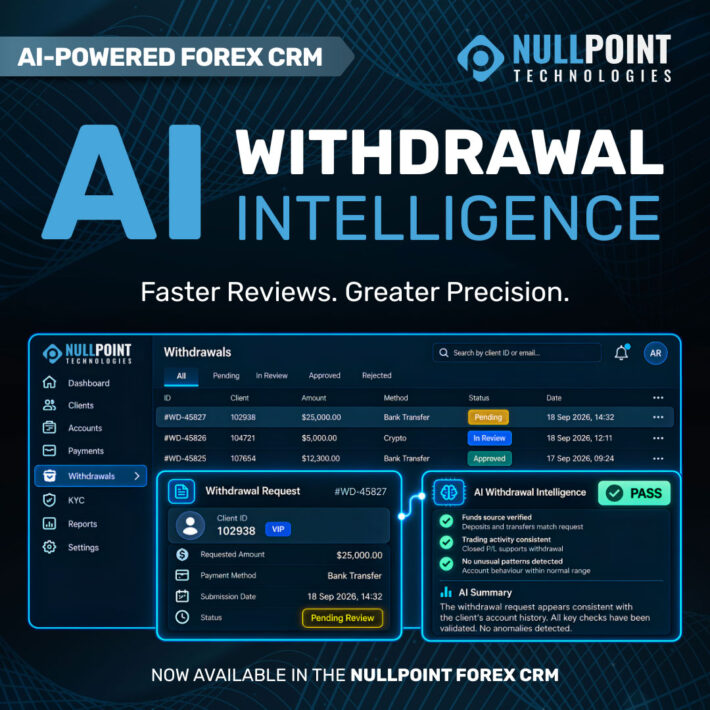
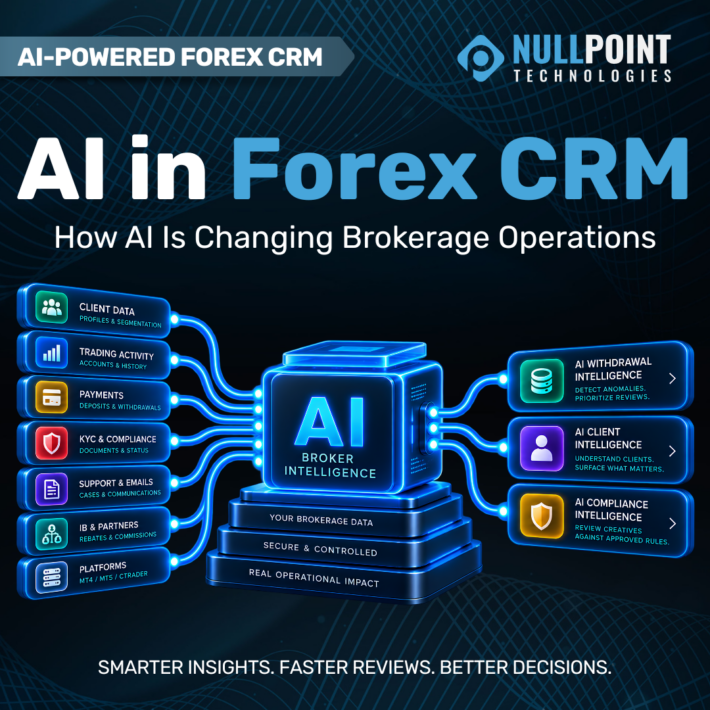
For example, AI Client Intelligence can help teams interpret client history and surface relevant context from CRM data, making it easier for sales and retention employees to understand relationships without manually reviewing every previous interaction.
The important distinction is that AI should complement structured CRM processes rather than replace reliable systems or human judgement.
The CRM remains the source of truth. AI helps interpret the available context. Employees remain responsible for decisions.
This principle can extend beyond client management into other brokerage workflows, including withdrawal review and operational intelligence.
What Should Brokers Look for in a Forex CRM with Client Portal?
When evaluating a Forex CRM with Client Portal, it is easy to compare platforms according to the number of features they advertise. A more useful approach is to evaluate how effectively the technology connects the major parts of the brokerage.
The CRM and Client Portal should provide a coherent client lifecycle from registration through onboarding and ongoing account management. Trading platforms should be meaningfully integrated. KYC and payment workflows should connect with the back office. IB relationships should integrate with client acquisition and account structures. APIs should provide enough flexibility for the brokerage’s technology stack to evolve.
The quality of the client-facing experience matters as well. Traders should be able to complete routine actions without unnecessary complexity, while employees should have enough information and automation to manage those processes efficiently.
Finally, the platform needs to scale.
The right CRM is not simply the system capable of supporting the brokerage today. It should provide an architecture that can accommodate more clients, more employees, more integrations, more partner relationships and potentially more brands without forcing the company to rebuild its operational infrastructure.
For a broader framework covering vendor evaluation, architecture, integrations, scalability and operational requirements, read our complete guide on how to choose a Forex CRM provider.
CRM and Client Portal Should Be One Connected System
The distinction between the internal CRM and the external Client Portal remains useful because they serve different users.
Operationally, however, they should behave as parts of the same brokerage infrastructure.
The trader interacts with registration, KYC, trading accounts, payments and account management through the Client Portal. Brokerage teams manage the corresponding relationships and workflows through the CRM. Trading platforms, payment providers, verification technology, IB infrastructure and other systems connect around them.
When these components work together, the brokerage can reduce manual processes while creating a more consistent experience for both clients and employees.
That is ultimately what brokers should look for in a modern Forex CRM with Client Portal: not simply two applications sold together, but a connected operational environment built around the complete client lifecycle.
Looking for a Forex CRM and Client Area built specifically for Forex and CFD brokerages? Explore the Nullpoint Forex CRM & Client Area or contact our team to discuss your brokerage requirements.