AI in Forex CRM: How AI Is Changing Brokerage Operations
Artificial intelligence is rapidly becoming part of the technology conversation across financial services, but for Forex and CFD brokers, the real question is not whether a CRM can claim to include AI. It is whether AI can solve specific operational problems inside the brokerage.
A modern Forex CRM already sits at the center of a large amount of operational information. Client profiles, trading accounts, deposits and withdrawals, KYC records, sales notes, follow-ups, support cases, emails and partner relationships can all pass through the same environment. The challenge is no longer simply collecting that data. It is helping brokerage teams understand and act on it efficiently.
This is where AI can become genuinely useful.
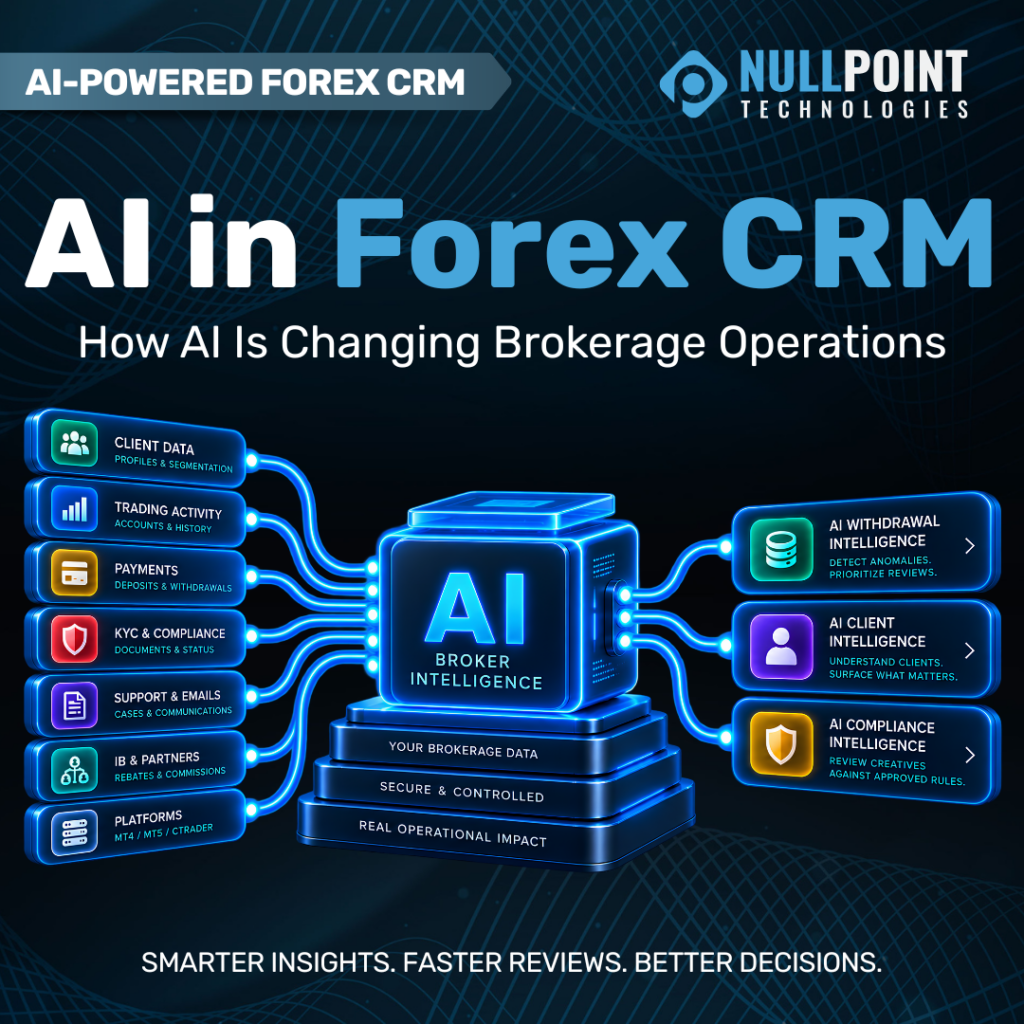
Rather than replacing the CRM’s underlying logic or allowing an AI model to make critical decisions autonomously, AI can work as an intelligence layer over existing brokerage data. It can summarize complex client histories, explain the result of deterministic checks, highlight information that deserves attention and give employees a better starting point for decisions that still remain under human control.
At Nullpoint, this is the approach we are taking as we introduce AI capabilities into our Forex CRM & Client Area. The objective is practical: reduce repetitive work, make brokerage data easier to interpret and help teams focus their attention where it matters.
From Forex CRM Automation to Forex CRM Intelligence
Automation has been part of Forex CRM technology for years. A CRM can automatically assign leads, trigger workflows, send communications, process account actions and connect with external systems. These functions are valuable because the rules are predictable: when something happens, the system knows what action should follow.
AI introduces a different capability.
Instead of only asking a system to execute a predefined workflow, brokers can use AI to interpret the information generated by those workflows. A client may have dozens of notes, multiple support cases, previous follow-ups, trading activity and a history of communications. The information exists, but understanding it can still require a person to search through several screens and reconstruct the situation manually.
The opportunity for AI in Forex CRM is to shorten the distance between having the data and understanding what that data means.
That distinction matters. A brokerage should not have to hand critical calculations or decisions to an opaque model simply to benefit from AI. The underlying CRM can continue to perform deterministic calculations and enforce configured business rules, while AI helps employees interpret the result.
This separation between calculation and interpretation is central to how Nullpoint is approaching AI within brokerage operations.
AI-Assisted Withdrawal Reviews
Withdrawal processing is a good example of a workflow where this approach can make a practical difference.
A pending withdrawal rarely exists in isolation. Before deciding how to handle a request, an operations employee may need to examine the client’s deposits, transfers, closed trading activity and platform balance operations. Most requests may be straightforward, but each still needs to be reviewed correctly.
Nullpoint’s AI Withdrawal Checks are designed to perform that initial examination before the agent opens the request.
The system reads the relevant account information and determines whether the requested withdrawal amount is supported. The AI then turns the result into a concise explanation displayed alongside the request, providing a pass or review verdict, the reasoning behind it and the specific points the employee may want to investigate.
There is an important technical distinction here: the arithmetic is performed by the system, not by the AI model. The AI is responsible for explaining what those numbers mean. As a result, the figures presented in the explanation come from the brokerage’s underlying ledger rather than being generated by the model.
The human employee remains responsible for the actual review and decision. What changes is the starting point.
Instead of opening every withdrawal request with a blank screen and manually reconstructing the client’s financial activity, the employee begins with a structured assessment and can concentrate on the cases that warrant closer attention.
This approach can also help surface inconsistencies that are easy to overlook during repetitive manual review. For example, the system can draw attention to unusual balance activity or situations such as a refund from a cancelled withdrawal being credited twice.
The purpose is therefore not to remove human oversight from withdrawals. It is to make that oversight more focused.
Turning Client Data Into AI-Powered Client Insights
Client management presents a different challenge.
A Forex CRM system may contain extensive information about a client, but more information does not automatically mean greater clarity. Over time, a single relationship can accumulate sales notes, follow-ups, support cases, emails, account activity and commitments made by different members of the brokerage team.
When an employee takes over the relationship, understanding its history may mean reading through a long sequence of records before making a call.
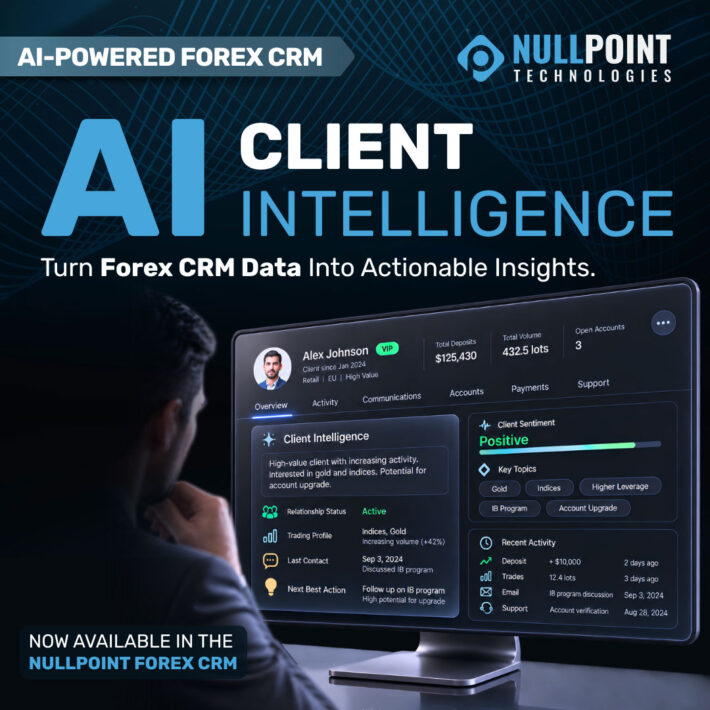
Nullpoint’s AI Client Insights are designed to make that information easier to use.
The functionality combines two layers: structured client scoring and on-demand relationship intelligence.
Client Scores and Flags
The CRM calculates a set of client flags and a client score on a recurring basis. Examples of these classifications include characteristics such as VIP, funded and scalper, together with a score out of 100 and the underlying breakdown.
Crucially, the score is stored as CRM data rather than simply displayed as an AI-generated observation. This means brokerage teams can use it within advanced searches and filters. An employee could, for example, retrieve clients above a particular score rather than manually building a list based on memory or individual judgement.
That turns client intelligence into something operational.
A score that cannot be searched, segmented or acted upon is little more than an interesting number. Once it becomes part of the CRM’s data model, it can help teams organize workflows and determine which groups of clients deserve attention.
AI Relationship Summaries
The second layer addresses the information accumulated around the client relationship itself.
When requested by an agent, the CRM can read relevant notes, follow-ups, support cases and emails sent to the client and produce a concise relationship summary.
Rather than merely shortening the text, the objective is to answer practical questions: Where does this relationship currently stand? What has already been promised? Who made those commitments? What should happen next?
Commitments include the date and the name of the person who made them.
This is particularly useful when ownership of a client changes between employees. A promise made several months earlier by another member of the team can easily disappear inside a long sequence of CRM notes. AI can surface that information without replacing the underlying client history.
The employee can understand the relationship quickly and still return to the original notes, cases or communications whenever additional detail is required.
AI Can Make Forex CRM Data More Actionable
This points toward a broader change in what a Forex CRM can do.
Traditional CRM systems are very good at storing information. Modern brokerage CRMs have gone further by connecting that information with trading platforms, payments, KYC, Client Areas and other operational systems.
AI introduces the possibility of making that connected information easier to interpret.
Consider the difference between these two questions: What information do we have about this client? and What does my employee need to know about this client right now?
The first is fundamentally a database problem. The second requires context.
A brokerage may already possess everything necessary to answer the second question, but the answer can be distributed across different records. AI can help assemble that information into something immediately understandable without removing access to the underlying data.
That has applications beyond sales. Operations teams can use interpreted information when reviewing transactions. Retention teams can understand the history of a relationship before contacting a client. Support teams can see relevant context without reconstructing an entire timeline. Managers can use structured scores and classifications to segment clients more systematically.
The CRM begins to move from being simply a system of record toward becoming a system that helps employees understand the records it contains.
AI Should Support Decisions, Not Hide Them
There is also an important risk in the way AI is being added to business software.
It is easy to put an AI-generated score, recommendation or verdict on a screen. It is much harder to make that output useful and trustworthy.
For brokerage operations, a black-box answer is often not enough.
If a withdrawal requires additional review, the employee needs to understand why. If a client has received a particular classification, the team should be able to inspect the information behind it. If an AI summary says that a commitment was made, the underlying CRM history should remain available.
This is why explainability should be part of the product design rather than an afterthought.
The AI Withdrawal Check, for example, does not simply return a label. It provides the reasoning and identifies the specific issues worth reviewing. The underlying financial calculation remains deterministic.
The same principle applies to Client Insights. A relationship summary does not replace the original client history. It makes that history easier to navigate.
For a brokerage, that distinction can be much more valuable than simply adding more AI-generated content to the interface.
Human Oversight Still Matters
AI also should not remove human responsibility from workflows where judgement matters.
A withdrawal assessment can give an operations employee a much stronger starting point, but the employee remains responsible for reviewing the case. A relationship summary can tell an account manager what has happened previously, but the account manager still decides how to handle the client.
This human-in-the-loop approach is particularly relevant in financial services.
The objective should be to remove unnecessary searching, repetitive checking and information reconstruction, not the judgement of the people responsible for the brokerage operation.
In practice, some of the most useful AI applications may therefore look less dramatic than autonomous decision-making. Reading a long sequence of CRM notes and surfacing the information an employee needs is useful. Reviewing several sources of account information and explaining why a withdrawal deserves attention is useful. Turning client characteristics into structured information that teams can search and segment is useful.
These are relatively focused applications, but they address work that brokerage employees actually perform.
AI and Brokerage Automation Are Not the Same Thing
It is also useful to distinguish AI from automation.
Automation follows rules. AI interprets information.
A brokerage needs both.
If a particular account action must always trigger another system action, traditional workflow automation is usually the appropriate solution. There is no benefit in asking an AI model to decide something that can be expressed reliably as a deterministic rule.
AI becomes more useful when the system needs to summarize, contextualize or explain a larger body of information.
The strongest Forex CRM architecture can therefore combine the two. The CRM and its integrations handle transactions, calculations, permissions and business rules. Automation executes predictable workflows. AI sits above that infrastructure where interpretation can make the workflow faster or easier for the employee.
This approach also reduces the temptation to use AI simply because it is available. The question becomes: What is the most reliable technology for this specific task?
Sometimes the answer is AI. Sometimes it is an API, a workflow, a database query or a deterministic calculation.
A modern brokerage technology stack should be able to use each where it makes sense.
Why Connected Brokerage Data Matters for AI
The quality of an AI feature depends heavily on the systems beneath it.
A standalone AI assistant has limited value if it cannot access the relevant brokerage context. To understand a client relationship, it needs the appropriate CRM history. To explain a withdrawal check, the system needs reliable transaction and trading-account information.
This makes Forex CRM integrations increasingly important.
A modern Forex CRM can sit between the brokerage’s client-facing and operational infrastructure, connecting information from MT4, MT5 and cTrader, the Client Area, payment infrastructure, KYC providers, IB management and other brokerage systems.
For MetaTrader environments, APIs can provide another important part of that connectivity layer. Brokers can use an MT4 API or MT5 API to connect trading-platform functionality with CRM systems, Client Areas and other applications.
Nullpoint also provides dedicated MT4 Web API and MT5 Web API solutions for brokers building connected MetaTrader environments.
The more structured that underlying environment becomes, the more opportunities there are to create useful intelligence on top of it.
This is one reason AI in brokerage technology should not be viewed as a standalone product layer. Its usefulness is closely connected to the quality of the CRM, integrations and data architecture underneath it.
For brokers evaluating AI functionality, the question should therefore not only be “Does the CRM have AI?”
A better question is: “What brokerage data can the AI actually understand, and what can our team do with the result?”
AI as Part of the Wider Brokerage Technology Stack
AI becomes more useful when it operates within a connected brokerage environment rather than as an isolated feature.
The Nullpoint Forex CRM & Client Area provides the operational layer for client management, onboarding, KYC, payments and brokerage workflows. The Forex IB & Partner Management System extends that environment across partner networks, commissions, rebates and payouts, while NP MetaSuite provides purpose-built MT4 and MT5 tools, plugins and APIs for brokerage infrastructure.
Connecting these operational layers creates the foundation for more useful intelligence because the CRM is no longer interpreting isolated records. It can work with context generated throughout the wider brokerage operation.
For brokers evaluating their technology stack, this also changes the role of the CRM. It is increasingly important to consider not only the features available today, but how easily the platform can connect with trading infrastructure, external providers and future automation or intelligence capabilities.
For a broader framework on evaluating this infrastructure, see our guide on how to choose a Forex CRM provider.
From More Data to Better Brokerage Operations
Forex brokers already generate large amounts of operational data. The next stage of CRM development is not simply collecting more of it. It is making existing information easier to understand and act upon.
That is where AI has the potential to become a meaningful part of brokerage operations. Not as a replacement for the people running the brokerage, and not as a black box making unexplained decisions, but as an intelligence layer that helps those people work with the information already available to them.
For Nullpoint, that means focusing AI development on specific operational problems.
AI Withdrawal Checks help operations teams begin a withdrawal review with an explanation rather than a blank screen.
AI Client Insights help sales and retention teams understand client relationships, identify commitments and work with structured client scores and classifications.
As these capabilities evolve, the principle remains the same: use deterministic systems where certainty is required, use AI where interpretation adds value, and keep people in control of decisions that require human judgement.
That is a more practical vision for AI in Forex CRM and one that can make artificial intelligence genuinely useful inside a modern Forex brokerage.
Frequently Asked Questions About AI in Forex CRM
What is an AI Forex CRM?
An AI Forex CRM combines traditional brokerage CRM functionality with artificial intelligence capabilities that can help interpret, summarize or prioritize operational information. Depending on the implementation, AI can support workflows such as client intelligence, relationship summaries and transaction review while the CRM continues to manage the underlying client and brokerage data.
How can AI be used in a Forex CRM?
AI can be used to summarize client histories, identify relevant relationship information, explain the results of operational checks and help brokerage employees prioritize information that requires attention. The most appropriate applications depend on the data available within the CRM and the brokerage’s workflows.
Can AI review Forex broker withdrawals?
AI can assist employees during withdrawal reviews by explaining information and highlighting areas that deserve attention. In Nullpoint’s implementation, the underlying arithmetic is performed by the system using brokerage data, while AI explains the result in plain language. The employee remains responsible for the review and decision.
Can AI help Forex brokers manage clients?
Yes. AI can help transform large amounts of CRM history into concise relationship summaries and make client information easier for sales and retention teams to use. Structured client scores and flags can also help teams segment and search their client base more systematically.
Does AI replace Forex CRM automation?
No. AI and automation solve different problems. Automation is best suited to predictable workflows and predefined rules, while AI can help interpret or summarize information where context is required. A modern Forex CRM can use both approaches together.
Does AI replace brokerage employees?
The objective of AI within a Forex CRM should be to support employees rather than remove human oversight from important operational decisions. AI can reduce repetitive information gathering and provide useful context, while brokerage employees remain responsible for actions requiring judgement.
Why is CRM integration important for brokerage AI?
AI is most useful when it has access to reliable and relevant context. Connecting the Forex CRM with trading platforms, payments, Client Areas and other brokerage systems creates the structured operational data that can support more useful AI-assisted workflows.
Bring More Intelligence Into Your Forex CRM
See how Nullpoint combines client management, brokerage automation, integrations and AI-assisted workflows in a Forex CRM & Client Area built specifically for Forex and CFD brokers.