
Multi-Brand Forex CRM | Manage Multiple Brokerage Brands from One Platform
Running Multiple Brokerage Brands Shouldn’t Mean Multiple Systems
As Forex and CFD brokerages grow, many expand beyond a single brand. They launch regional brands, regulated entities, white labels or specialized offerings to serve different markets and client segments.
While this strategy increases market reach, it also introduces operational complexity.
Without the right technology, teams can end up managing multiple databases, duplicate client records, disconnected reporting, inconsistent sales processes and fragmented compliance workflows.
A Multi-Brand Forex CRM addresses these challenges by allowing multiple brokerage brands to operate independently while being managed through a centralized technology environment.
Instead of building a separate operational stack every time the brokerage launches another brand, the business can expand using shared infrastructure while maintaining the individual configurations, workflows and identities required by each operation.
What Is a Multi-Brand Forex CRM?
A Multi-Brand Forex CRM enables brokerages to manage multiple brands, websites, Client Areas and business entities from a centralized system.
Each brand can maintain its own identity, configuration and operational rules while sharing the underlying technology infrastructure.
This allows brokerages to scale more efficiently without multiplying operational costs or administrative workload every time another brand is introduced.
The difference becomes particularly important as the organization grows. Managing two brands through separate systems may initially seem manageable. As the brokerage expands across additional brands, jurisdictions, payment environments and trading servers, however, duplicated infrastructure can quickly become an operational burden.
A purpose-built Forex CRM & Client Area should therefore provide the flexibility to support expansion without forcing every new business unit into an entirely separate technology stack.
Why Brokerages Launch Multiple Brands
Operating multiple brokerage brands has become common across the Forex industry.
Some firms expand internationally, while others create specialized brands targeting different audiences or regulatory jurisdictions.
Common reasons include:
- Expanding into new regions and languages
- Operating under different regulatory licenses
- Separating retail and institutional clients
- Offering different trading conditions
- Creating niche or premium brands
- Launching white-label brokerages
- Testing new marketing strategies
- Serving clients with different payment options
The business case for multiple brands can vary considerably, but the technology challenge is similar: each operation may need to remain distinct without forcing the brokerage to duplicate every internal system and workflow.
Managing these brands independently quickly becomes inefficient without a centralized CRM.
Operate Multiple Regulated Entities with Greater Control
Many brokerage groups operate several legal or regulated entities to serve clients across different jurisdictions.
For example, a brokerage group may operate entities authorized or regulated in different markets, each with its own legal, compliance and operational requirements.
Each entity may require its own brand identity, website and Client Area, legal documentation, terms and conditions, KYC workflows, payment providers, trading servers, compliance procedures and reporting requirements.
A Multi-Brand Forex CRM can allow each entity to maintain the required operational separation while still being administered through a centralized platform.
This distinction is important.
Centralized management should not mean forcing every entity to operate identically. The objective is to give the brokerage a common technology foundation while preserving the configuration required for individual brands and business entities.
For brokerage groups planning this type of expansion, these requirements should be considered when choosing a Forex CRM provider rather than after the technology has already been deployed.
Centralized Management with Independent Branding
One of the biggest advantages of a Multi-Brand CRM is centralized administration.
Administrators can manage multiple brands from a common environment while each brand maintains its own logo and visual identity, website and Client Area, registration forms, email templates, trading accounts, payment methods, marketing campaigns, bonus programs and Introducing Broker structure.
From the client’s perspective, each brand can provide its own distinct experience.
Internally, however, the brokerage avoids unnecessarily duplicating the infrastructure required to manage those operations.
This becomes particularly valuable for brokerage groups that want to launch additional brands while maintaining consistency in the technology and processes used behind them.
Separate Client Areas for Different Brokerage Brands
The Forex Client Area is one of the most visible components of a multi-brand architecture because it is where clients interact directly with the brokerage.
Different brands may require different logos, domains, registration experiences, payment options, communications and other configurations.
A brokerage targeting several markets may also need different languages or localized experiences depending on the brand.
The underlying CRM should therefore support this separation without forcing the brokerage to maintain completely unrelated client-management systems for each operation.
This allows each brand to preserve its own identity while the brokerage benefits from a more centralized operational environment.
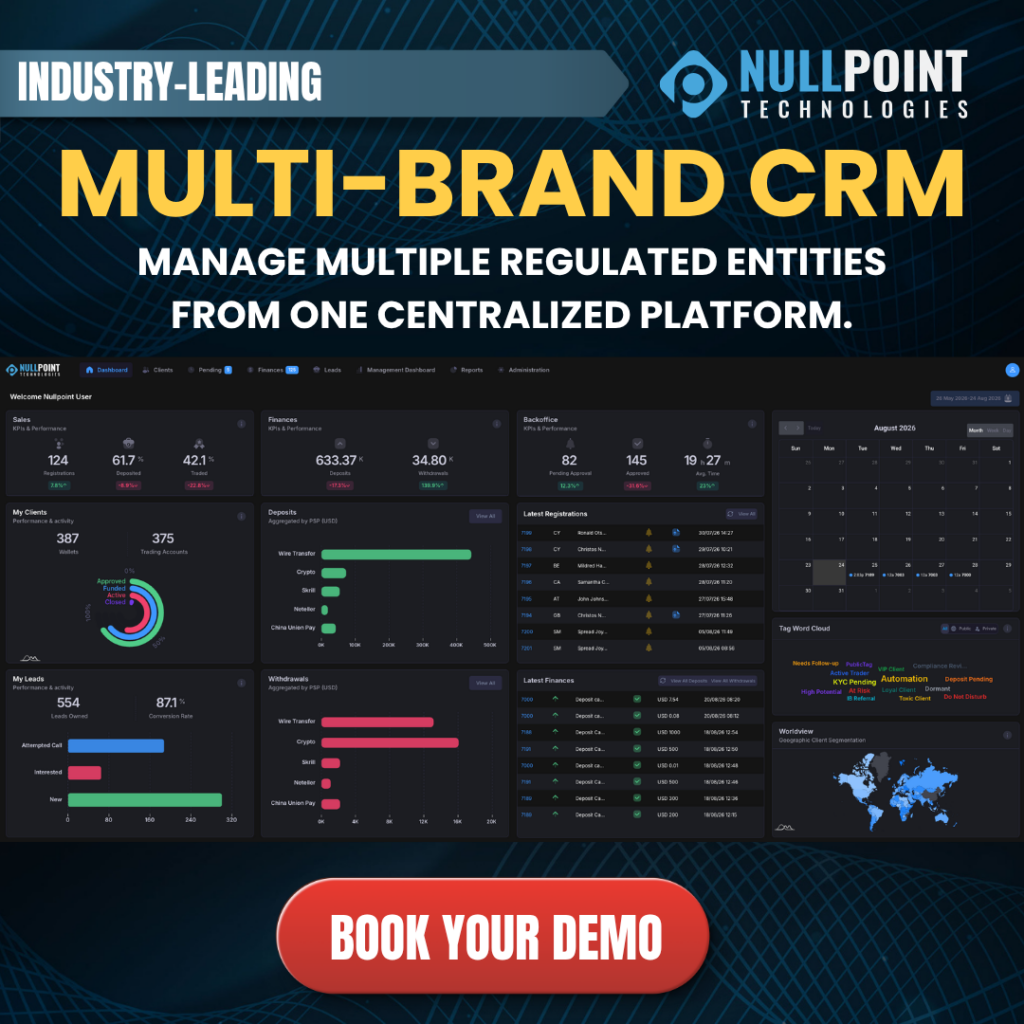
One Dashboard. Complete Visibility.
Instead of switching between multiple CRM installations, management can gain broader visibility across the brokerage group from a centralized environment.
Depending on the implementation, management may need to monitor metrics such as new registrations, First-Time Deposits, active traders, KYC completion, deposit and withdrawal volumes, sales performance, revenue by brand, geographic distribution, conversion rates and team performance.
The important advantage is not simply having more dashboards.
It is being able to understand individual brands while also maintaining a consolidated view of the wider organization.
Executives can compare operations across brands and use centralized reporting to identify differences in acquisition, conversion and operational performance without manually combining information from completely separate CRM environments.
Shared Infrastructure. Lower Operational Complexity.
Maintaining separate CRM installations for every brokerage brand can significantly increase infrastructure costs and administrative effort.
Every additional environment may require its own configuration, maintenance, integrations, user management and operational processes.
A Multi-Brand Forex CRM allows brokerages to share a common technology platform while keeping each brand logically separated.
This can contribute to lower infrastructure requirements, easier software updates, faster deployment of new brands, simplified maintenance, more consistent business processes and reduced staff training.
The result is a more scalable operation without sacrificing the flexibility required by individual brands.
This is also where the distinction between configuration and customization becomes important. Brokerages should understand which elements of a new brand can be configured internally, which require provider involvement and which require custom development before committing to a CRM architecture.
Flexible Permissions for Every Team
Different teams require access to different brands.
A modern Multi-Brand CRM should therefore provide granular permission management, allowing staff to access only the brands and functions relevant to their role.
A sales manager may be assigned to a specific brand, while a compliance officer may work only with clients belonging to a particular entity. Marketing teams may manage dedicated campaigns, finance departments may oversee selected operations and senior management may require visibility across the wider organization.
This improves security while simplifying day-to-day operations.
It can also become increasingly important as the brokerage grows internationally. A centralized CRM should not mean that every employee automatically receives access to every brand, client or operational function.
Connect Multiple Brands to MT4, MT5 and cTrader
Trading-platform connectivity is another important part of a multi-brand architecture.
One brand may operate an MT5 environment while another uses MT4 or cTrader. Larger brokerage groups may also operate multiple servers or trading environments across several brands.
The CRM therefore needs to understand which clients and trading accounts belong to which operation while maintaining the appropriate connection with the underlying trading infrastructure.
This is why trading-platform connectivity should be evaluated beyond a simple “MT5 supported” or “MT4 supported” checkbox.
For MetaTrader environments, technologies such as an MT4 API and MT5 API can also provide additional connectivity between the trading platform and external brokerage applications.
Brokerages evaluating an MT5-focused environment can also read our guide to choosing the best MT5 CRM, which examines the wider requirements around MT5 integration, Client Area, KYC, payments, IB management, automation and scalability.
Integrate Every Brand with the Right Technology
Although each brokerage brand may operate differently, they can all be managed through the same CRM environment.
The wider technology stack may include:
- MetaTrader 4
- MetaTrader 5
- cTrader
- Payment Service Providers
- KYC providers
- Email platforms
- SMS gateways
- VoIP systems
- Marketing automation platforms
- Business intelligence tools
The important requirement is flexibility.
One brand may need a particular payment provider because of the market it serves, while another may use a completely different payment infrastructure. Different entities may also require separate KYC configurations or communications providers.
A Multi-Brand CRM should accommodate those differences without affecting unrelated brands.
This makes the quality and flexibility of Forex CRM integrations particularly important. Brokers should evaluate not only which integrations already exist but also how new providers can be added as the business expands.
MT4 and MT5 APIs in a Multi-Brand Environment
As a brokerage’s technology architecture becomes more sophisticated, API connectivity can provide additional flexibility.
A brokerage may want to develop its own Client Area components, internal applications, reporting interfaces or operational workflows around its trading infrastructure.
For MT4 environments, the Nullpoint MT4 Web API provides a way for external systems to interact with MetaTrader 4.
Similarly, the Nullpoint MT5 Web API can connect MetaTrader 5 with CRM systems, Client Areas and other brokerage applications.
This becomes especially relevant in multi-brand environments where the brokerage may want to build technology and workflows around different trading environments without treating each platform as an isolated system.
For a deeper technical overview, see our guides to MT4 APIs for Forex brokers and MT5 APIs for Forex brokers.
Multi-Brand IB & Partner Management
Client operations are not the only part of the brokerage that becomes more complicated as additional brands are introduced.
Partner networks can also span multiple operations.
Different brands may work with different IBs, commission structures, campaigns and commercial arrangements. A brokerage may also operate hierarchical partner networks in which regional or master partners manage additional sub-IBs.
A dedicated Forex IB & Partners Management System can help automate these structures while connecting partner acquisition with the wider brokerage environment.
For more complex networks, our guide to multi-level Forex IB systems explains how hierarchical partner structures, referral attribution, commissions and payouts can be managed as the network grows.
This is important because multi-brand expansion should not create a separate manual partner-management problem alongside the CRM.
Maintain Different Payment Environments
Payment infrastructure can differ significantly between brands.
A brokerage operating in several markets may use different Payment Service Providers, currencies and payment methods depending on the region, legal entity or client segment.
The CRM and Client Area therefore need enough flexibility to present the appropriate payment environment to the appropriate clients while giving internal teams visibility over the resulting transactions.
This is another area where CRM and payment integrations become critical.
The objective should not simply be to connect as many payment providers as possible. It should be to ensure that each brand can use the providers required for its operational model without unnecessarily complicating the wider brokerage infrastructure.
Keep KYC and Onboarding Workflows Brand-Specific
Onboarding requirements may also vary between brands and entities.
Different operations may require different registration information, verification processes, documentation or internal approval workflows.
A Multi-Brand Forex CRM should therefore allow the brokerage to structure onboarding around the requirements of the individual operation rather than forcing every client through an identical process.
At the same time, internal teams should be able to manage these workflows efficiently from the broader CRM environment.
This balance between centralized administration and brand-specific configuration is one of the fundamental requirements of a scalable multi-brand architecture.
Build to Scale
Launching a new brokerage brand should not require rebuilding the entire operational infrastructure.
With a Multi-Brand Forex CRM, new brands can be deployed using an established technology foundation while configuring the workflows, integrations and operational processes required for the new business.
Whether the brokerage manages two brands or considerably more, the CRM architecture should be capable of growing alongside the organization.
Scalability should therefore be evaluated before deployment.
Can another brand be added? Can another trading server be connected? Can the new operation use different payment providers? Can access be restricted to a dedicated team? Can another Client Area be configured? Can additional partner structures be introduced?
These questions are more useful than simply asking whether the CRM technically supports “multi-brand.”
Multi-Brand CRM as Part of the Wider Brokerage Technology Stack
A CRM is only one component of brokerage infrastructure.
As the organization grows, it may also require specialized trading-platform tools, APIs, partner-management technology and technical services.
Nullpoint’s NP MetaSuite provides purpose-built MT4 and MT5 tools and plugins for brokerage operations, while MT4 & MT5 services cover areas including platform administration, server management and development.
A modular technology architecture allows the brokerage to use the CRM as its client and operational layer while specialized systems handle other requirements around trading infrastructure.
The objective is not to make one application perform every function. It is to ensure that the different components of the brokerage technology stack work together effectively.
What Should Brokers Look for in a Multi-Brand Forex CRM?
The most important question is not simply whether a CRM provider advertises multi-brand support.
Brokerages should establish what that actually means operationally.
Can each brand maintain its own Client Area and visual identity? Can different payment and KYC providers be configured? Can trading infrastructure differ between brands? Can employees be restricted to specific operations? Can reporting be viewed individually and across the wider group? Can another brand be introduced without deploying an entirely separate CRM?
The answers determine whether the platform genuinely provides a scalable multi-brand architecture or simply offers limited branding variations within a single environment.
If you’re comparing providers, our complete guide on how to choose a Forex CRM provider covers the broader evaluation process, including Client Area capabilities, trading-platform connectivity, KYC, payments, IB management, automation, customization and scalability.
Why Choose Nullpoint Technologies?
At Nullpoint Technologies, our Forex CRM & Client Area is designed specifically for Forex and CFD brokerages, including organizations operating multiple brands and business entities.
Brokerages can manage multiple brands and Client Areas through a centralized technology environment while maintaining operational separation where required.
From client onboarding and KYC to payments, sales automation, IB management, reporting and integrations, the objective is to reduce the operational complexity that typically accompanies brokerage expansion.
The wider Nullpoint ecosystem also includes Forex IB & Partners Management, Forex CRM integrations, MT4 & MT5 tools and plugins and MT4 & MT5 brokerage services.
Whether a brokerage is launching another regional brand or managing a wider group of operations, the technology architecture should provide the flexibility, scalability and control required to expand without unnecessarily multiplying systems.
Ready to Manage Every Brand from One Platform?
A Multi-Brand Forex CRM can help brokerages expand into new markets, operate multiple business entities and manage different brands from a centralized technology environment while preserving the configurations each operation requires.
If your brokerage is planning to expand, the CRM architecture should be designed for that growth before operational complexity begins to multiply.