Best MT5 CRM: How to Choose the Right CRM for Your Brokerage (2026 Guide)
Launching or scaling a Forex brokerage involves much more than connecting to MetaTrader 5. As your client base grows, so does the complexity of managing leads, compliance, trading accounts, payments, partner commissions, support requests and operational reporting.
This is where an MT5 CRM becomes one of the most important components of your technology stack.
A modern Forex CRM connects every department within your brokerage, from sales and onboarding to compliance, finance, operations and IB management, into a single platform. Instead of relying on disconnected spreadsheets, manual processes and multiple third-party systems, your team works from one centralized environment that improves efficiency, reduces operational complexity and creates a better experience for both clients and employees.
In this guide, we’ll explain what an MT5 CRM is, why it matters, the essential features every brokerage should look for and the common mistakes to avoid before choosing a solution.
What Is an MT5 CRM?
An MT5 CRM, or MetaTrader 5 Customer Relationship Management system, is software designed specifically for Forex and CFD brokerages.
Unlike generic CRMs such as Salesforce or HubSpot, an MT5 CRM integrates with MetaTrader 5 and the wider brokerage technology stack, allowing brokerages to manage the client lifecycle without constantly switching between disconnected systems.
A purpose-built MT5 CRM typically combines:
- Lead Management
- Sales Pipeline
- Client Area or Trader’s Room
- KYC & Compliance
- Trading Account Management
- Payment Processing
- Finance & Back Office
- IB Management
- Reporting & Analytics
- Automation Workflows
Because these functions are connected, information only needs to be entered once. Sales teams, compliance officers, finance departments and management can work from the same environment, reducing manual effort and improving operational visibility.
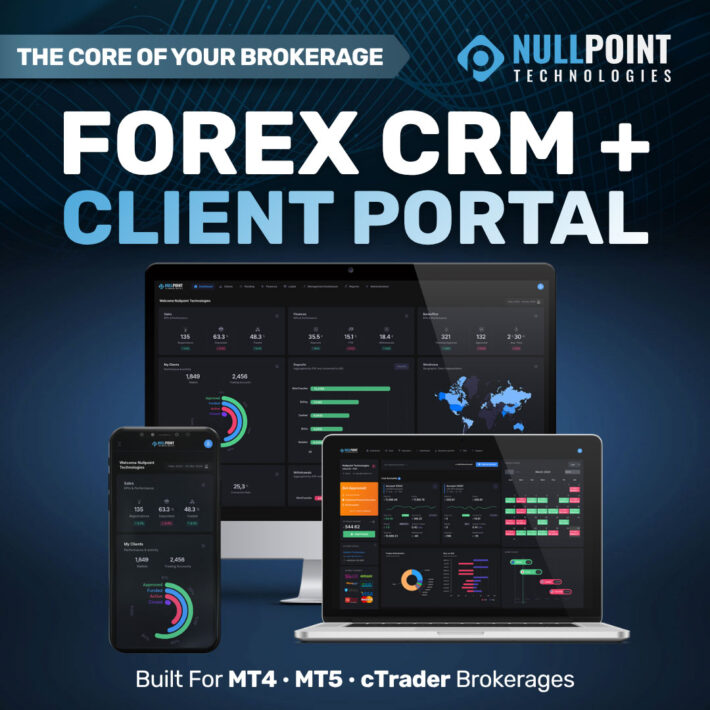
For brokers evaluating this type of technology, a dedicated Forex CRM & Client Area should be considered as part of the brokerage’s wider operational infrastructure rather than simply as a sales database.
Why Generic CRMs Don’t Work for Forex Brokerages
One of the biggest mistakes new brokerages make is assuming that any CRM can manage a brokerage.
While platforms such as Salesforce, HubSpot or Zoho excel in traditional sales environments, they weren’t designed around the specialized operational requirements of Forex and CFD brokers.
A brokerage needs capabilities that generic CRMs typically don’t provide out of the box, including:
- Direct MT4 and MT5 integration
- Automatic trading account creation
- Trading account synchronization
- Trader’s Room / Client Portal
- KYC workflows
- Deposit and withdrawal management
- Multi-level IB commissions
- Payment Service Provider integrations
- Operational reporting
- Trading activity visibility
Trying to recreate these workflows using a generic CRM can result in extensive custom development, disconnected systems and additional maintenance requirements.
A purpose-built Forex CRM addresses this by bringing brokerage-specific processes together within a connected environment.
Why Every Growing Brokerage Needs an MT5 CRM
As trading volumes and client numbers increase, operational complexity grows with them.
Without the right systems in place, teams can quickly become overwhelmed by repetitive manual tasks. Sales teams manually assign leads, compliance chases missing KYC documents, finance processes deposits and withdrawals, partners request commission reports and management exports spreadsheets simply to understand daily performance.
These operational bottlenecks can slow down growth and increase costs.
An MT5 CRM centralizes these processes and automates many of the repetitive tasks that consume valuable time.
The result can be faster onboarding, more efficient compliance processes, improved sales productivity and better visibility across the brokerage.
The Business Benefits of an MT5 CRM
Although every brokerage has different objectives, several benefits consistently make a purpose-built CRM valuable.
Faster Client Onboarding
Modern brokerages compete on speed.
The faster a prospect can register, complete KYC, open a trading account and make their first deposit, the sooner that prospect can become an active client.
An integrated Forex Client Area can streamline this process by bringing registration, document uploads, trading-account creation and funding into a consistent client experience.
Better Sales Performance
Sales teams perform best when they have complete visibility.
An MT5 CRM can provide lead pipelines, activity tracking, follow-up reminders, conversion analytics and agent performance metrics.
Managers can use this information to understand campaign performance, identify conversion bottlenecks and allocate resources more effectively.
Improved Compliance
Compliance processes form a significant part of brokerage onboarding.
An integrated CRM can help brokerages manage identity verification, document collection, appropriateness assessments, AML workflows, audit trails and client status management.
Connecting the CRM with external KYC and brokerage integrations can further reduce the number of separate systems employees need to manage during onboarding.
Increased Operational Efficiency
Rather than using separate systems for sales, finance, compliance and partner management, an MT5 CRM centralizes operations into one platform.
This reduces duplicate work, minimizes errors and enables teams to respond more quickly to clients.
Automation can further improve efficiency by handling repetitive workflows such as email notifications, task assignments, KYC reminders, account approvals, partner commission calculations and deposit confirmations.
Better Client Experience
Today’s traders expect more than a trading platform.
They expect a modern digital environment where they can open accounts, upload documents, deposit funds, request withdrawals, monitor trading accounts, access information and manage personal details.
A well-designed Forex CRM & Client Area, sometimes referred to as a Trader’s Room, becomes the primary digital touchpoint between the client and the brokerage.
How an MT5 CRM Fits Into Your Brokerage Technology Stack
Many brokers think of a CRM as a standalone application.
In reality, it becomes the operational hub connecting major components of the brokerage.
A modern MT5 CRM may need to communicate with MetaTrader 5, MetaTrader 4, cTrader, Payment Service Providers, KYC providers, email services, SMS providers, VoIP systems, marketing platforms, internal applications and APIs.
Rather than replacing these systems, the CRM should help orchestrate them into connected workflows.
This is why Forex CRM integrations should be evaluated as carefully as the CRM interface itself. A platform may look impressive in a demonstration, but its long-term value depends heavily on how effectively it can connect with the technology the brokerage already uses or plans to introduce.
For MetaTrader 5 specifically, an MT5 API can provide another important layer of connectivity between the trading platform and systems such as the CRM, Client Area, payments and proprietary brokerage applications.
What Makes a Great MT5 CRM?
Not every CRM built for Forex offers the same capabilities.
When evaluating solutions, brokerages should focus less on marketing claims and more on whether the platform can support their actual operational model and long-term growth.
The following 15 areas provide a practical framework for evaluating an MT5 CRM.
15 Essential Features Every MT5 CRM Should Include
1. MetaTrader 5 Integration
The most important capability of an MT5 CRM is its integration with MetaTrader 5.
Without effective connectivity, teams may need to rely on manual processes, duplicated data or additional development to exchange information between the CRM and trading platform.
Depending on the implementation, the CRM may need access to information and operations involving trading accounts, balances, equity, trading activity, groups, leverage and client information.
The important question when comparing providers is therefore not simply whether they advertise “MT5 integration”, but what the integration actually allows the brokerage to do.
Brokerages requiring additional connectivity between MetaTrader 5 and external systems should also evaluate the role of an MT5 Web API. For a more detailed explanation, see our complete guide to MT5 APIs for Forex brokers.
2. A Modern Client Area (Trader’s Room)
Today’s traders expect more than just a trading platform.
They want a secure online portal where they can manage their relationship with the brokerage.
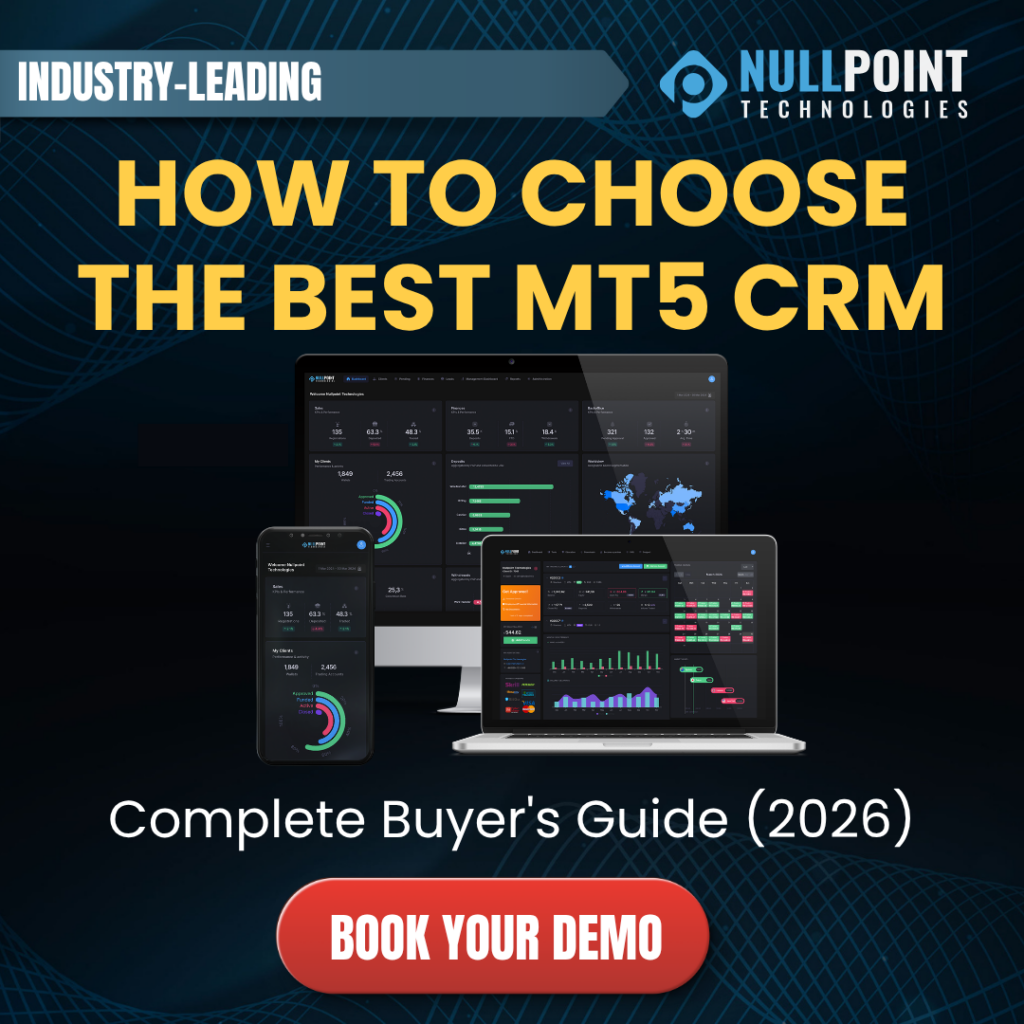
A modern Client Area may allow clients to register online, complete KYC, open trading accounts, deposit funds, request withdrawals, transfer funds, view account information, access promotions and manage personal information.
The Client Area becomes the digital front door of the brokerage and plays a significant role in the overall client experience.
Explore the Nullpoint Forex CRM & Client Area →
3. Automated KYC & Compliance
Compliance should be incorporated into the CRM workflow rather than managed entirely through emails and spreadsheets.
A modern solution should support processes such as identity verification, document collection, KYC reminders, manual approval workflows, audit trails and client status tracking.
Automation can reduce onboarding time while helping compliance teams process clients more efficiently.
The ability to connect external KYC providers is also important, making the CRM’s integration ecosystem an important consideration when comparing platforms.
4. Multi-Level IB & Partner Management
For many brokerages, IBs are an important acquisition channel.
Managing a large partner network manually quickly becomes unsustainable.
A sophisticated Forex IB & Partners Management System can support hierarchical partner networks, automated referral attribution, multiple commission models, partner portals, commission automation, performance analytics and payout workflows.
The requirements become particularly important as the network grows beyond a simple relationship between one IB and a group of referred traders.
For a detailed explanation of the architecture behind these networks, see our guide to multi-level Forex IB systems.
5. Payment Gateway Integrations
Funding should be straightforward for both clients and finance teams.
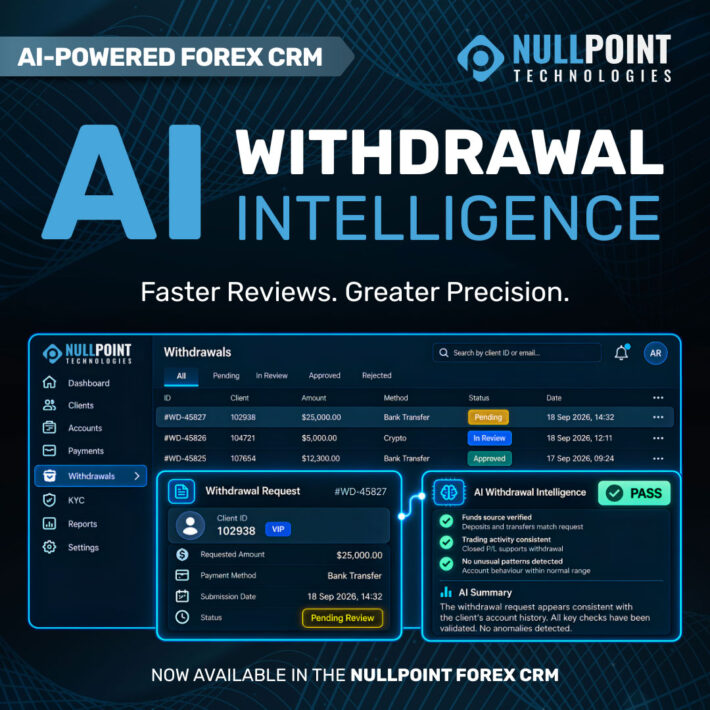
A modern MT5 CRM should be capable of integrating with multiple Payment Service Providers, allowing the brokerage to manage deposits, withdrawals, transaction history, payment methods and transaction statuses within the wider client workflow.
Supporting multiple providers can also give brokerages greater flexibility across different markets and jurisdictions.
When evaluating providers, don’t simply count the payment logos displayed on a website. Examine how those payment and CRM integrations actually operate within the Client Area and back office.
6. CRM Automation
One of the biggest advantages of a modern CRM is automation.
Instead of relying on employees to initiate every routine process, workflows can execute automatically based on client activity or predefined rules.
Examples include welcome emails, KYC reminders, deposit confirmations, task creation, sales notifications, birthday campaigns, reactivation campaigns and internal alerts.
Automation improves consistency while allowing teams to concentrate on higher-value work.
The objective should not simply be to add more automation features. It should be to reduce unnecessary manual intervention across the client lifecycle.
7. Sales Pipeline Management
Every lead represents a potential client.
Without visibility into the sales process, opportunities can easily be lost.
An effective CRM should provide sales pipelines, lead assignment, follow-up reminders, activity history, conversion tracking and agent performance dashboards.
Managers can then identify bottlenecks and understand how effectively leads progress toward registration, verification and First-Time Deposit.
8. Back Office & Finance Tools
A CRM should simplify financial operations rather than complicate them.
Key capabilities may include deposit management, withdrawal approvals, internal transfers, credit adjustments, transaction history, manual balance operations and financial reporting.
A centralized back office improves operational efficiency while reducing the need for teams to move repeatedly between separate administrative systems.
9. Reporting & Business Intelligence
A brokerage generates substantial amounts of operational data.
A CRM should help transform that information into something management can use.
Useful reporting can cover new registrations, FTD conversion, deposit volumes, withdrawal statistics, sales performance, IB performance, campaign effectiveness and client activity.
As brokerage technology develops further, CRM reporting can also sit alongside more specialized brokerage intelligence and risk systems rather than attempting to make the CRM responsible for every form of analytics.
10. Multi-Brand Support
Many brokerages eventually operate multiple brands, websites, teams or entities.
Managing each environment independently can create unnecessary operational duplication.
A multi-brand Forex CRM can allow individual brands to maintain their own branding, Client Areas, payment environments, communications and other configurations while being administered through a more centralized technology environment.
If multi-brand expansion is part of the brokerage’s strategy, this requirement should be considered before selecting the CRM rather than after the infrastructure has already been deployed.
Read the complete Multi-Brand Forex CRM guide →
11. APIs & Integrations
Every brokerage has different operational requirements.
An MT5 CRM should therefore provide sufficient flexibility to connect with payment gateways, marketing platforms, business intelligence tools, internal portals, proprietary applications and third-party services.
The quality of these Forex CRM integrations becomes increasingly important as the technology stack grows.
MetaTrader connectivity deserves particular attention. An MT5 Web API can allow external brokerage systems to interact with MetaTrader 5 for operations such as trading-account management, balance operations, account information and other workflows.
This allows the broker to build technology around MT5 rather than treating the trading platform as an isolated system.
12. Multi-Language & Localization
International brokerages serve clients across different markets.
The CRM and Client Area may therefore need to accommodate multiple languages, currencies, localized communications, regional branding and country-specific workflows.
Localization is not simply a translation exercise. The technology needs sufficient flexibility to support differences in the way the brokerage operates across its target markets.
13. Security & Access Control
A CRM stores sensitive business and client information.
Brokerages should therefore evaluate the platform’s authentication, permissions, auditability and access-control architecture carefully.
Different departments and employees require different levels of access, making granular role and permission management particularly important in larger organizations.
Security should also be considered across integrations. Connecting additional systems creates additional interfaces through which sensitive brokerage operations or information may flow.
14. Scalability
The CRM selected today should still support the brokerage as the business grows.
Consider whether the platform can accommodate higher client volumes, additional brands, more employees, new markets, additional trading environments and new integrations.
Replacing core CRM infrastructure after significant growth can be costly and operationally disruptive.
This is why scalability should be evaluated in terms of architecture and flexibility rather than simply the number of clients a provider claims its platform can handle.
For brokers evaluating the provider itself as well as the product, our guide to how to choose a Forex CRM provider provides a broader framework for comparing technology partners.
15. Dedicated Forex Broker Tools
The technology surrounding the CRM can extend beyond client management.
Brokerages may also require purpose-built tools for trading-platform administration, risk controls, fee management, swaps, balance operations, historical trading data and other operational processes.
Nullpoint’s NP MetaSuite provides MT4 and MT5 tools and plugins designed specifically for brokerage operations.
These include technology across areas such as fee management, trading controls, administrative automation and Web API connectivity.
The important distinction is that the CRM does not need to perform every technical function itself. A more modular architecture allows the CRM, trading platform and specialized brokerage tools to work together as part of the wider technology stack.
Common Mistakes When Choosing an MT5 CRM
Selecting a CRM is a long-term technology decision. Choosing the wrong platform can create operational challenges that become increasingly difficult to correct as the brokerage grows.
Common mistakes include choosing based on price alone, ignoring API availability, underestimating future scalability, overlooking automation capabilities, failing to evaluate support quality, choosing a platform without a capable Client Area, ignoring IB management requirements and forgetting about future multi-brand requirements.
Another common mistake is evaluating features individually without examining how they work together.
A CRM may technically support MT5, KYC, payments and IB management, but the important question is whether those components form coherent workflows across the brokerage.
Taking time to evaluate these factors upfront can prevent significant operational problems later.
Questions Every Brokerage Should Ask Before Choosing an MT5 CRM
Before making a decision, ask potential providers:
- How does the CRM integrate with MT5, and what can that integration actually do?
- Can it manage multiple brokerage brands?
- Does it include a Client Area?
- How are IB networks and commissions managed?
- Are APIs available?
- Which payment and KYC providers are supported?
- Can workflows be automated?
- How frequently is the platform updated?
- What can the brokerage configure itself?
- What requires custom development?
- What deployment options are available?
- How are additional integrations handled?
- What onboarding and ongoing support are provided?
- Can the technology scale alongside additional clients, brands and trading infrastructure?
These questions help ensure the brokerage evaluates solutions based on long-term operational requirements rather than short-term convenience.
Frequently Asked Questions
What is an MT5 CRM?
An MT5 CRM is a Customer Relationship Management platform designed for Forex and CFD brokerages that connects with MetaTrader 5 and helps manage clients, trading accounts, onboarding, compliance, payments, sales and partner operations.
What is the best MT5 CRM?
The best MT5 CRM depends on the brokerage’s operational model, trading infrastructure, client journey, integrations, partner structure and future growth requirements.
Rather than selecting a provider based purely on the number of advertised features, brokers should evaluate the depth of MT5 integration, Client Area, automation, payments and KYC connectivity, IB management, APIs, customization and scalability.
Can an MT5 CRM automate KYC?
An MT5 CRM can incorporate KYC processes such as document collection, verification workflows, reminders, approvals and client status management. The exact capabilities depend on the CRM and the KYC providers integrated with the brokerage.
Does an MT5 CRM support IBs?
Purpose-built Forex CRMs can work alongside dedicated IB & Partners Management functionality for multi-level partner networks, referrals, commissions, rebates, campaigns and payouts.
Brokerages with more sophisticated partner structures should evaluate IB management as core infrastructure rather than simply an additional CRM feature.
Can an MT5 CRM manage multiple brands?
Advanced CRM platforms can support multiple brands or operational environments while maintaining centralized management.
For a deeper explanation, see our Multi-Brand Forex CRM guide.
Can I connect payment providers?
A Forex CRM can integrate with Payment Service Providers so deposits and withdrawals form part of the wider client and back-office workflow.
The available providers and depth of the connection vary between platforms, which is why brokers should evaluate Forex CRM integrations rather than simply checking whether a provider’s logo appears on an integration page.
What is an MT5 API?
An MT5 API allows external systems and applications to interact with MetaTrader 5.
For a brokerage, this can make it possible to connect MT5 with technology such as a Forex CRM, Client Area, payments or proprietary applications and automate operations that would otherwise require manual intervention.
Read our MT5 API for Forex Brokers guide or explore the Nullpoint MT5 Web API.
Choosing the Best MT5 CRM for Your Brokerage
Choosing the right MT5 CRM is about more than selecting software. It means choosing part of the operational foundation on which the brokerage will run.
The right platform should simplify onboarding, reduce repetitive work, connect the brokerage’s technology stack, support sales and compliance teams, provide clients with a modern digital experience and accommodate increasingly sophisticated partner and operational requirements.
It should also leave room for the brokerage to evolve.
New payment providers may need to be connected. Additional brands may be launched. Partner networks may become more complex. Proprietary applications may be developed. Trading infrastructure may expand beyond a single MT5 environment.
For that reason, the best MT5 CRM is not simply the platform with the longest feature list. It is the platform whose architecture, integrations and operational model fit the brokerage today while providing sufficient flexibility for what comes next.
Nullpoint’s Forex CRM & Client Area is built specifically for Forex and CFD brokerages and connects client management, onboarding, KYC, payments, trading accounts, sales and back-office operations within a unified environment. The wider Nullpoint ecosystem includes Forex IB & Partners Management, Forex CRM integrations, MT4 & MT5 tools and plugins and MT4 & MT5 brokerage services.