
How to Choose a Forex IB Management System
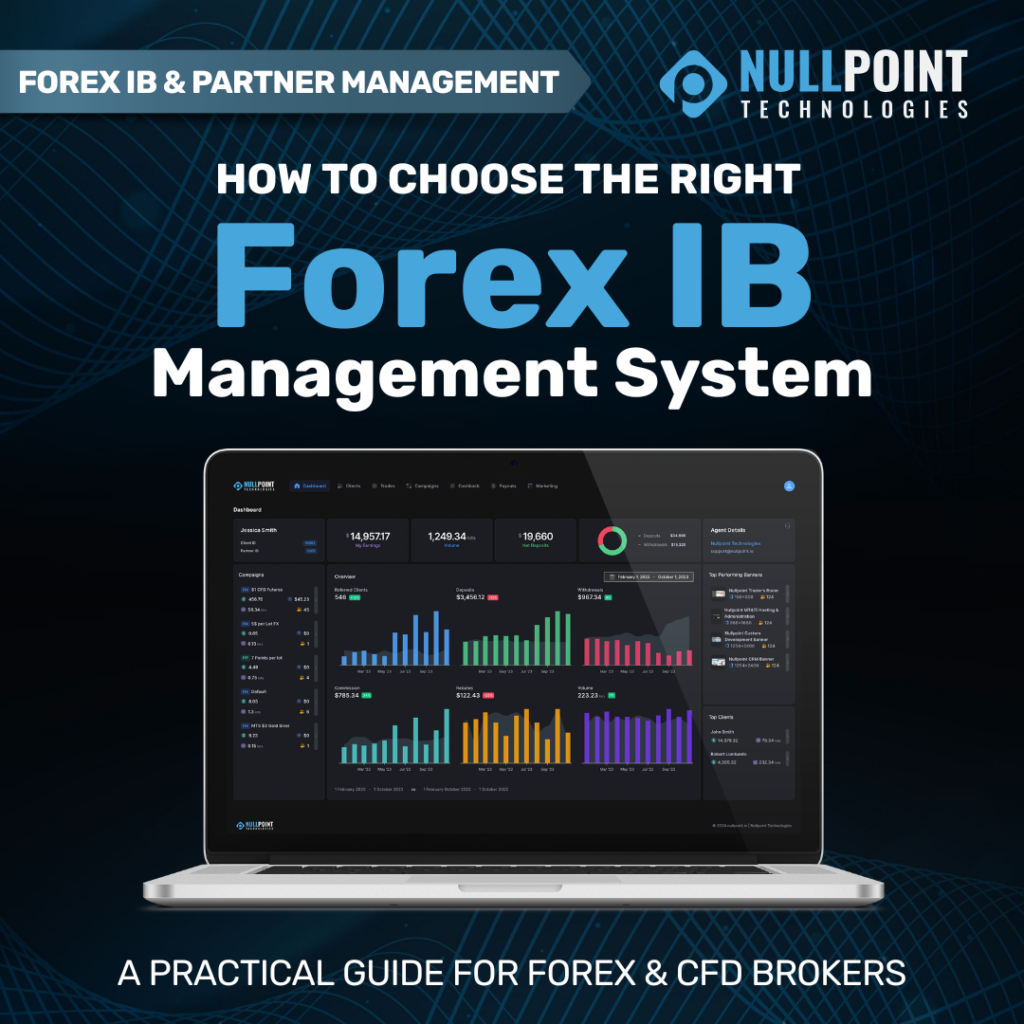
Introducing Brokers can become one of the most important acquisition channels for a Forex or CFD brokerage. As a partner network grows, however, managing referrals, commissions, sub-IBs, campaigns and payouts becomes increasingly complex.
A simple structure involving one IB and a group of referred traders may eventually develop into a network containing master partners, regional IBs, sub-IBs and thousands of clients operating under different commercial agreements.
This is where a dedicated Forex IB Management System becomes essential.
The right platform can automate referral attribution, commission calculation, partner hierarchies, reporting and payouts while giving both the brokerage and its partners greater visibility into performance.
Choosing the right IB system therefore requires more than comparing dashboards or checking whether the platform can calculate a rebate.
Brokerages need to understand whether the technology can support the commercial complexity, partner structure and operational scale they expect to have in the future.
In this guide, we’ll examine the most important capabilities to evaluate when choosing an IB Management System for a Forex or CFD brokerage.
What Is an IB Management System?
An IB Management System is technology designed to help brokerages manage their Introducing Broker and partner networks.
At its most basic level, the system connects referred clients with the partner responsible for introducing them and calculates the commissions generated by their activity.
More sophisticated platforms go considerably further.
They can manage multi-level partner hierarchies, different commission models, campaign structures, partner portals, cashback, CPA incentives, automated payouts and detailed commission reporting.
For brokerages operating large partner networks, the Forex IB & Partners Management System becomes part of the brokerage’s core commercial infrastructure rather than simply an affiliate portal.
It should also connect naturally with the wider brokerage technology stack, including the Forex CRM and trading platforms used by the business.
Why Brokerages Need Dedicated IB Management Technology
A small partner programme can sometimes be managed through spreadsheets and relatively simple commission calculations.
That approach becomes increasingly difficult as the network grows.
Different IBs may negotiate different commercial agreements. Some may introduce traders directly, while others recruit additional partners. Commission rates may differ between instruments, account types or campaigns. Clients may move between partners, and payouts may require different approval processes.
Without dedicated infrastructure, brokerage teams can end up manually reconciling referrals, trading activity and commission calculations across multiple systems.
An IB Management System allows these relationships to be structured and automated.
The objective is not simply to calculate commissions faster. It is to create an infrastructure capable of supporting a growing partner network without forcing the brokerage’s operational workload to grow at the same rate.
What to Look for in an IB Management System
Different brokerages operate different partner models, so there is no universal configuration suitable for every business.
There are, however, several capabilities that should form part of almost every serious evaluation.
1. Multi-Level IB Support
One of the first questions to ask is whether the platform can manage hierarchical partner networks.
In a simple IB structure, one partner refers traders directly to the brokerage.
In a multi-level structure, an IB may also recruit additional partners beneath them.
For example:
Brokerage → Master IB → Regional IB → Sub-IB → Trader
The system needs to maintain the relationship between every level so trading activity from the final client can be attributed correctly throughout the network.
A proper multi-level Forex IB system should automate this hierarchy rather than requiring brokerage staff to reconstruct relationships manually.
It should also allow the brokerage to define how the available commission is distributed between the different tiers.
This becomes particularly important as the network expands. Maintaining accurate attribution across a few dozen partners is relatively straightforward. Doing the same across thousands of clients and several levels of IBs requires much more structured infrastructure.
2. Automated Referral Attribution
Creating multiple levels is only useful if the platform can reliably determine where referred clients belong.
When a trader registers through an IB referral link, the system should associate that client with the appropriate partner and campaign.
If that client later becomes an IB, the platform should be capable of maintaining the relationship with the original referring partner while creating the new branch beneath them.
This means future traders introduced by the new IB remain connected to the correct hierarchy.
Automated attribution reduces the amount of manual administration required to maintain the partner network and provides the foundation for accurate commission calculation.
When evaluating a provider, ask exactly how referral links, campaigns, clients, trading accounts and sub-IB relationships are connected.
3. Flexible Commission Models
Not every partner should necessarily operate under the same commercial agreement.
A brokerage may compensate one IB according to trading volume while another receives a share of generated revenue. Strategic partners may negotiate more sophisticated arrangements combining several compensation methods.
The IB platform should therefore support commission structures that reflect the brokerage’s actual commercial model.
Nullpoint’s IB & Partners Management System supports multiple approaches including Fixed per Lot, Pip Value-Based, Spread Share, USD per Million, Revenue Share, Hybrid and CPA arrangements.
The important consideration is flexibility.
Brokerages should understand whether different models can be assigned to different partners, whether several campaigns can operate simultaneously and how easily commercial agreements can be modified as partner relationships evolve.
A platform that forces every IB into the same rebate model can become restrictive as the partner network becomes more sophisticated.
4. Campaign-Based Commission Management
Commission logic should not necessarily be hard-coded directly into individual partner profiles.
A campaign-based architecture gives the brokerage more flexibility.
Campaigns can define how commissions are generated, which trading conditions apply and which partners participate in a particular commercial arrangement.
This allows the brokerage to separate the structure of the partner network from the commercial agreement used to compensate it.
One partner may participate in multiple campaigns, while the same campaign may be assigned to several partners.
This can become particularly useful when operating different markets, product groups, acquisition strategies or negotiated partner arrangements.
When evaluating an IB platform, ask how commission campaigns are created, assigned, modified and maintained.
5. Symbol-Level Commission Control
A single rebate rate across every instrument may not accurately reflect the economics of a multi-asset brokerage.
The commercial characteristics of EURUSD, gold, indices, cryptocurrencies and other CFDs can differ substantially.
A sophisticated IB platform should therefore allow the brokerage to control commission conditions at a more granular level.
For example, the brokerage may want different partner costs for different securities or product categories.
Nullpoint’s system allows commission costs to be configured across securities and individual symbol costs to be overridden when more specific conditions are required.
This gives the brokerage greater control over partner economics without requiring a completely separate campaign for every individual instrument.
6. MT4 and MT5 Group Controls
Trading-account conditions can also affect whether partner commission should be generated.
Different MT4 or MT5 groups may operate with different spreads, commissions, leverage or account structures.
Some may be eligible for IB commissions while others should be excluded.
The IB platform should therefore allow the brokerage to determine which trading groups qualify for commission generation.
This provides an additional control layer and helps prevent partner commissions from being generated under trading conditions for which the agreement was not intended.
For MetaTrader brokerages, this is also why the depth of trading-platform connectivity matters.
Technologies such as an MT4 API or MT5 API can provide additional connectivity between MetaTrader and external brokerage applications.
7. Real-Time Partner Dashboards
IBs should have visibility into the business they generate.
A dedicated partner portal can allow them to monitor referred clients, trading activity, commissions, payouts and other relevant performance information without repeatedly requesting reports from the brokerage.
This improves transparency while reducing administrative workload for account managers and finance teams.
The brokerage needs visibility as well.
Administrators should be able to examine the performance of individual partners and understand the wider network, including sub-IB structures and different branches of the hierarchy.
As the network grows, this becomes increasingly important because the brokerage needs to identify not only its largest individual partners but also the partner networks responsible for meaningful client and trading activity.
8. Detailed Commission Reporting
Complex commission structures inevitably generate questions.
An IB may want to know why a particular trade generated a particular commission. Finance may need to reconcile a payout. Management may want to compare campaigns, while operations may need to investigate a client or trading account.
The reporting environment therefore needs to provide more than headline commission totals.
Brokerages should evaluate whether the system can provide trade-level commission information, partner performance, paid and unpaid commissions, campaign data, client financial activity and payout history.
The ability to trace a commission back to the underlying trading activity becomes particularly important when several compensation models operate simultaneously.
Transparent reporting helps reduce disputes because both the brokerage and partner have clearer visibility into how the resulting commission was generated.
9. Flexible Payout Workflows
Commission calculation is only one side of IB management.
The brokerage eventually needs to settle those commissions.
Different partner relationships may require different payout processes.
Some IBs may receive scheduled automatic payouts, while others require manual review. The brokerage may also want to allow partners to submit payout requests through their portal.
A scalable IB Management System should therefore support different settlement workflows.
Thresholds can also be useful. Minimum payout amounts can prevent inefficient micro-payments, while unusually large payouts may require additional review before settlement.
The objective is to automate routine payments while preserving appropriate operational control where necessary.
10. Cashback Management
Some partners return a portion of their commission to the traders they introduce.
If cashback forms part of the brokerage’s partner model, the IB system should be capable of supporting it without requiring commissions to be manually recalculated outside the platform.
A flexible implementation may allow the brokerage to establish campaign-level cashback while giving selected partners additional control over cashback arrangements for individual referred clients.
This allows standardized programmes and individually negotiated relationships to coexist within the same partner infrastructure.
11. CPA and Hybrid Partner Agreements
Partner acquisition models are becoming increasingly sophisticated.
A brokerage may want to reward an IB when a qualified client reaches a particular activation threshold and then continue paying commissions based on the client’s subsequent trading activity.
This requires the platform to support more than a single compensation mechanism.
CPA incentives may depend on conditions such as the client’s first deposit, trading volume or a combination of qualifying criteria.
Hybrid structures can then combine acquisition-based incentives with recurring commission models.
When choosing an IB system, determine whether these commercial structures can coexist automatically or whether the brokerage will need to reconcile different compensation mechanisms manually.
12. CRM Integration
The IB relationship should not exist in isolation from the client relationship.
If a trader registers through an IB, the brokerage should be able to understand both sides of that relationship.
The Forex CRM & Client Area manages the wider client lifecycle, while the IB system manages the partner structure responsible for the acquisition.
Connecting the two allows partner attribution to remain part of the broader brokerage environment.
This becomes useful for sales, support, finance and operations teams because they can understand the client’s relationship with the brokerage while maintaining the commercial connection to the referring partner.
When evaluating providers, ask how the IB system communicates with the CRM and whether partner attribution remains synchronized as client relationships or trading accounts change.
13. MT4, MT5 and cTrader Integration
The IB platform also needs access to the trading activity used to calculate commissions.
For brokerages operating MT4, MT5 or cTrader, trading-platform integration therefore becomes fundamental.
The important question is not simply whether a provider advertises compatibility with a particular platform.
Ask how trades are processed, how volume is interpreted, how trading accounts are associated with partners and campaigns and how changes to account groups or trading infrastructure affect commission generation.
If your brokerage operates a wider technology ecosystem, the quality of its brokerage integrations should form part of the IB-system evaluation.
For MetaTrader environments requiring additional connectivity, Nullpoint also provides dedicated MT4 Web API and MT5 Web API technology.
14. Partner and Campaign Reassignment
Partner relationships change.
A client may need to move from one IB to another. A partner may negotiate a new commercial agreement. A brokerage may restructure campaigns or change the conditions under which particular trading accounts operate.
The IB system needs to accommodate these changes without destroying the historical relationship between trading activity and previously generated commissions.
Brokerages should therefore ask whether clients or accounts can be transferred between partners and campaigns, whether changes can be performed individually or in bulk and how historical commission calculations are handled.
This becomes particularly important at scale because manual corrections across thousands of accounts can create substantial operational risk.
15. Commission Recalculation
Errors and commercial changes can occur before settlement.
An account may have been associated with the wrong campaign, a client may have been assigned to the wrong partner or trading-group mappings may have changed.
A capable IB platform should provide a controlled mechanism for recalculating affected commissions before they are finalized.
There should also be a clear boundary between commissions that can still be adjusted and commissions that have already been paid.
This is an important operational control that is easy to overlook when evaluating systems based only on front-end features.
16. Security, Permissions and Auditability
An IB Management System handles commercially sensitive information.
Not every employee should have the same access to partner data, commission configurations or payout operations.
Role-based permissions allow the brokerage to control which teams and employees can access specific functions.
Auditability is equally important.
When commission rules, campaigns, partner relationships or payouts change, the brokerage should be able to understand what happened and maintain appropriate operational records.
Security should therefore be evaluated across the complete environment rather than treated as a simple login feature.
17. Scalability
The IB system should be selected based not only on the network the brokerage operates today but also on what that network could become.
A platform that works well with 20 IBs may behave very differently once the business manages hundreds of partners, several levels of sub-IBs and thousands of referred trading accounts.
Scalability should therefore include more than technical capacity.
Ask whether the platform can accommodate additional hierarchy levels, new commission models, more campaigns, additional trading servers, multiple brands, different payment workflows and changing partner agreements.
A scalable architecture allows the commercial model to become more sophisticated without forcing the brokerage to replace its partner infrastructure.
Key Questions to Ask an IB Management System Provider
Before selecting a provider, brokers should ask a consistent set of questions:
- Does the system support multi-level IB and sub-IB structures?
- How is referral attribution handled?
- Which commission models are supported?
- Can partners participate in multiple campaigns?
- Can commission conditions differ by symbol or product?
- Can commission eligibility be controlled by MT4 or MT5 group?
- Do IBs receive their own partner portal?
- Can administrators explore the complete partner hierarchy?
- How detailed is trade-level commission reporting?
- Can the platform support automatic, manual and requested payouts?
- Does it support CPA and hybrid arrangements?
- Can cashback be managed within the system?
- How does it integrate with the brokerage’s CRM?
- Which trading platforms are supported?
- Can clients or accounts be reassigned between partners and campaigns?
- Can commissions be recalculated before settlement?
- What role-based permissions and audit controls are available?
- Can the platform scale to the partner structure we expect to have in several years?
These questions provide a much stronger basis for comparison than simply asking whether a provider offers an “IB module.”
IB Management System vs Basic Affiliate Software
It is also important to distinguish between basic affiliate tracking and a complete brokerage IB Management System.
A simple affiliate platform may be capable of tracking a referral and applying a straightforward reward.
A brokerage operating sophisticated partner networks may require much more.
Trading activity needs to be associated with referred accounts. Different commission models may operate simultaneously. Partners may sit within multi-level hierarchies. Instrument and account-group conditions may affect commission eligibility. Payouts need to be managed, and every resulting commission may need to be traceable back to the underlying activity.
That is why brokerages should evaluate an IB platform as commercial infrastructure, not simply as referral software.
For a deeper look at how these networks operate technically and commercially, read our guide to Multi-Level Forex IB Systems.
IB Management as Part of the Wider Brokerage Technology Stack
Partner management does not operate independently from the rest of the brokerage.
The IB system may need to communicate with the CRM, Client Area, MT4, MT5, cTrader and other technologies used by the business.
This makes integration architecture particularly important.
A connected environment allows client acquisition, partner attribution and trading activity to remain part of the same wider operational ecosystem.
Nullpoint’s Forex CRM & Client Area provides the client-management layer, while the Forex IB & Partners Management System handles the commercial relationships between partners, referred traders and their activity.
Brokerages can also extend their MetaTrader infrastructure through NP MetaSuite MT4 & MT5 tools and plugins and dedicated APIs where additional connectivity or automation is required.
The objective is not to force one application to perform every brokerage function. It is to ensure that specialized systems can work together effectively.
Why Brokerages Choose Nullpoint for IB Management
The Nullpoint Forex IB & Partners Management System is designed specifically for Forex and CFD brokerages that need to automate and scale partner operations.
The platform supports hierarchical partner networks and automated referral attribution alongside flexible commercial models including Fixed per Lot, Pip Value-Based, Spread Share, USD per Million, Revenue Share, Hybrid and CPA arrangements.
Brokerages can configure commission conditions around their commercial model, control eligibility across trading environments, manage partner and campaign relationships, automate different payout workflows and maintain detailed reporting around the resulting commissions.
The platform also provides visibility across the partner network so brokerage teams can understand individual IB performance as well as the wider downline structure.
For brokerages operating more sophisticated networks, the objective is to provide the infrastructure required for partner programmes to become more complex without forcing the operational workload to become equally complex.
Frequently Asked Questions
What is an IB Management System?
An IB Management System is software used by brokerages to manage Introducing Brokers, referred clients, partner hierarchies, commissions, campaigns, reporting and payouts.
More sophisticated systems can also support multi-level IB structures, several commission models, cashback, CPA incentives and detailed trade-level commission validation.
What is a multi-level IB system?
A multi-level IB system allows partners to introduce both traders and additional partners.
This creates a hierarchy in which a trader may belong directly to one IB while that IB belongs to another partner further up the network.
The system maintains this relationship and distributes commissions according to the brokerage’s configured tier structure.
Read our complete guide to Multi-Level Forex IB Systems for a detailed explanation.
What commission models should an IB Management System support?
The appropriate models depend on the brokerage’s commercial strategy.
Nullpoint supports Fixed per Lot, Pip Value-Based, Spread Share, USD per Million, Revenue Share, Hybrid and CPA structures.
The important consideration is whether the system gives the brokerage sufficient flexibility to structure different agreements for different partners and campaigns.
Can an IB system integrate with MT4 and MT5?
Yes. A brokerage IB platform can integrate with trading infrastructure such as MT4 and MT5 so referred trading accounts and eligible trading activity can be incorporated into commission calculations.
Brokers should evaluate the depth of the integration rather than relying only on a provider stating that MetaTrader is supported.
Should an IB Management System integrate with the Forex CRM?
Yes. The Forex CRM manages the wider client relationship, while the IB system manages the partner responsible for referring that client.
Connecting these systems helps maintain consistent attribution between clients, trading accounts and partners as part of the wider brokerage environment.
Can an IB Management System support CPA and Revenue Share?
A flexible IB platform can support different commercial models, including CPA and Revenue Share.
More sophisticated systems can also combine several compensation mechanisms within Hybrid campaigns so a partner can receive an acquisition incentive as well as commissions generated by subsequent client activity.
Can an IB Management System automate payouts?
Yes. Depending on the implementation, payouts can be processed automatically, manually reviewed or initiated through partner requests.
Brokerages may also apply thresholds and other controls according to their settlement requirements.
How do I choose the right IB Management System?
Start by documenting how your brokerage actually operates its partner programme.
Consider the hierarchy, commission models, campaigns, trading platforms, reporting requirements, payout processes, CRM connectivity and expected future scale.
Then ask each provider to demonstrate how the system would handle those specific scenarios rather than comparing feature lists alone.
Final Thoughts: Choose Infrastructure That Can Grow With Your Partner Network
The right IB Management System should do more than calculate rebates.
It should provide the infrastructure required to manage the complete commercial relationship between the brokerage, its partners and the clients they introduce.
That means maintaining referral attribution, supporting sophisticated commission structures, automating payouts, providing transparent reporting and connecting partner operations with the wider brokerage technology stack.
Most importantly, the system should be capable of supporting the partner network the brokerage expects to have in the future, not simply the one it operates today.
For brokerages evaluating their partner infrastructure, explore the Nullpoint Forex IB & Partners Management System or read our technical guide to Multi-Level Forex IB Systems.