
MT5 CRM: The Complete Guide for Forex Brokers
MetaTrader 5 has become a central part of the technology infrastructure used by many Forex and CFD brokerages. It provides the trading environment through which clients access markets, manage positions and interact with their trading accounts. But running a brokerage requires considerably more than a trading platform.
Before a client places a trade, they need to register, complete verification, fund an account and potentially interact with a sales or support team. After the trading account is created, the brokerage still needs to manage payments, communications, Introducing Broker relationships, reporting and the wider client lifecycle.
This is where an MT5 CRM becomes important.
An MT5 CRM connects MetaTrader 5 with the client-facing and operational systems surrounding the trading platform. Instead of treating MT5, onboarding, KYC, payments, sales and partner management as disconnected processes, the CRM provides a central environment from which the brokerage can manage the relationship between them.
For brokers evaluating CRM technology, however, simply seeing “MT5 integration” on a feature list is not enough. The more important question is what that integration allows the brokerage to do.
What Is an MT5 CRM?
An MT5 CRM, or MetaTrader 5 CRM, is customer relationship management software designed for brokerages operating with MetaTrader 5. It connects client management and brokerage workflows with the trading environment, allowing information associated with a trader and their trading accounts to be managed within a wider operational context.
A conventional CRM is primarily designed to organize leads, customers, communications and sales activity. A Forex CRM has to account for a much more specialized relationship.
A brokerage client can have multiple trading accounts, make deposits and withdrawals, complete KYC requirements, belong to an Introducing Broker network, interact with different sales teams and generate ongoing trading activity. The CRM therefore needs to understand not only who the client is, but how that client interacts with the brokerage.
An MT5 CRM extends this model by connecting those workflows with MetaTrader 5.
The result is not a replacement for MT5. The trading platform continues to perform its own role. The CRM instead provides the operational layer around it, connecting the trading account with the broader client relationship.
Why Do Forex Brokers Need a CRM Alongside MetaTrader 5?
MetaTrader 5 is a trading platform, not a complete brokerage management environment.
That distinction becomes increasingly important as a brokerage grows.
Consider what happens before a new client reaches the point of trading. The client may first enter the brokerage through a marketing campaign, sales relationship or Introducing Broker. They then register, provide personal information, complete verification, access the Client Area, make a deposit and create or request a trading account.
Once active, that same client may open additional accounts, communicate with the brokerage, make further deposits or withdrawals, participate in promotions and remain associated with a partner or IB structure.
MT5 handles the trading component of that relationship. The Forex CRM manages much of what surrounds it.
Without a connected CRM environment, teams can end up working across separate systems to understand the same client. Sales may work from one platform, finance from another, compliance from another and trading operations directly from the trading environment.
As client volumes and operational complexity increase, that fragmentation can become difficult to manage.
An MT5 CRM helps create a central client view around which those different workflows can be organized.
How Does an MT5 CRM Integration Work?
The phrase MT5 CRM integration can describe very different levels of connectivity.
At its most basic, an integration allows information to move between the CRM and MetaTrader 5. But brokers should look beyond whether a connection technically exists and consider what operational processes it actually supports.
A useful integration should allow the CRM to understand the relationship between the client and their trading accounts. That means brokerage teams can work with relevant client and account information without treating the CRM and trading platform as entirely separate environments.
This distinction matters during technology selection.
Two CRM providers can both advertise MetaTrader 5 support while providing very different operational experiences. One may offer limited connectivity around basic account information, while another may incorporate the trading relationship more deeply into client management, payments, partner attribution and other workflows.
For that reason, brokers should evaluate integration depth rather than the presence of an MT5 logo alone.
The right question is not simply:
“Does this CRM integrate with MT5?”
It is:
“What can our brokerage actually do through that integration?”
MT5 CRM Client Management
The client profile is one of the most important components of a brokerage CRM.
A sales employee may need to understand where the client came from, which trading accounts belong to them and their current stage in the client lifecycle. Operations may need access to account information and financial activity. Compliance teams may need verification information and documentation.
If these details exist across disconnected systems, employees spend more time reconstructing the client relationship.
An MT5 CRM should provide a centralized client environment connecting relevant CRM information with the client’s trading-account relationship.
This becomes particularly valuable when clients operate more than one account. Rather than treating every trading account as an isolated record, the brokerage can understand the wider relationship around the individual client.
As operations become more complex, this centralized view can also help teams coordinate their work without relying on repeated exports, spreadsheets or manual reconciliation between systems.
The Client Area Is a Critical Part of an MT5 CRM
The administrative CRM is only one side of the system. For the trader, the Client Area is often the primary point of interaction with the brokerage outside the trading platform itself.
A well-designed Client Area gives clients a centralized environment for managing their relationship with the broker. Registration, verification, funding and trading-account management can be brought together rather than distributed across separate interfaces.
This makes the relationship between the CRM, Client Area and MT5 particularly important.
The trader should not experience these systems as unrelated pieces of technology. From their perspective, opening and managing a trading account should form part of a coherent brokerage journey.
The same applies internally. Actions taken by the client through the Client Area should fit into the wider operational workflows managed through the CRM.
For brokers comparing MT5 CRM software, the quality of the Client Area therefore deserves as much attention as the administrative interface.
MT5 CRM Onboarding and KYC
Client onboarding is one of the first areas where disconnected technology can create unnecessary operational work.
A new client may need to provide personal information, submit documentation and complete identity verification before gaining full access to brokerage services. Depending on the brokerage and jurisdiction, additional requirements may also form part of the process.
A Forex CRM can structure this journey so that registration, document collection and KYC requirements form part of a connected onboarding workflow.
Third-party KYC and identity-verification providers can also be integrated into the environment, allowing the brokerage to build verification technology around its operational requirements.
The objective is not simply to digitize a registration form. It is to create a structured path from prospect to verified client and ultimately to an active trading relationship.
When the CRM, Client Area, verification process and trading environment work together, the brokerage can reduce the amount of manual coordination required between these stages.
Payments and PSP Management in an MT5 CRM
Payments are another major component of the client lifecycle.
Brokerages often work with multiple payment service providers because client requirements vary across markets, currencies and payment methods. As the number of providers increases, the operational environment can become increasingly complex.
An MT5 CRM can help connect payment activity with the wider client relationship.
Instead of viewing deposits and withdrawals purely as isolated transactions, relevant financial activity can be understood alongside the client profile and trading-account relationship.
For the trader, payment integrations within the Client Area can provide a more consistent funding experience. For the brokerage, connecting payment workflows with the CRM can give operational teams greater visibility into client financial activity.
When evaluating a provider, brokers should therefore consider not only which PSP integrations are available today, but also how easily the technology stack can evolve as payment requirements change.
A brokerage expanding into new markets may need additional providers in the future. A CRM that restricts the business to a narrow integration ecosystem can eventually become a constraint.
MT5 CRM for Sales and Retention Teams
Forex CRM technology should also support the commercial side of the brokerage.
Sales teams need more than a database of names and contact information. They need enough context to understand where each client is within the relationship and determine which actions require attention.
A centralized CRM can bring together client information, communications, segmentation and relevant activity so that sales and retention teams can operate from a more complete client picture.
This becomes particularly important as the brokerage scales.
When hundreds or thousands of clients are distributed across teams, regions or brands, relying on individual knowledge becomes increasingly difficult. Structured workflows and centralized information allow the brokerage to maintain a more consistent operating process.
The objective is not simply to give sales teams more data. It is to give them the information required to understand the client without searching across multiple systems.
MT5 CRM and Introducing Broker Management
For many Forex and CFD brokers, Introducing Brokers are a significant acquisition channel. This adds another layer of complexity to the CRM environment because a client may simultaneously belong to a trading relationship and a partner relationship.
The brokerage needs to understand who introduced the client, where that relationship sits within the wider IB structure and how trading activity relates to the applicable commercial arrangement.
This is why IB Management should not be considered completely separately from CRM architecture.
A connected environment can allow the brokerage to manage partner attribution, multi-level structures, commissions, rebates, partner activity and reporting while maintaining the relationship between the IB and the underlying clients.
For brokerages with large partner networks, this becomes increasingly important. A simple one-level referral model may be manageable with limited technology. Multi-level structures involving master IBs, sub-IBs, different remuneration models and large numbers of referred clients require considerably more control.
When evaluating an MT5 CRM, brokers with meaningful partner operations should therefore examine the IB system in detail rather than treating it as a secondary feature.
Reporting and Analytics
A brokerage generates information across many areas of the business. Client acquisition, deposits, withdrawals, trading activity, partner relationships and operational processes all create data.
Reporting becomes significantly more useful when these areas can be understood in relation to each other.
A CRM can help centralize operational and client information so that management teams have a clearer view of what is happening across the brokerage.
The important question is not simply how many reports a system provides. It is whether those reports reflect the information the brokerage actually needs to manage its operation.
A dashboard with dozens of metrics can still provide poor visibility if the underlying data remains fragmented.
Brokers should therefore evaluate reporting based on relevance, flexibility and the ability to connect information across different parts of the client lifecycle.
What Should Brokers Look for in an MT5 CRM?
There is no single feature that determines whether an MT5 CRM is suitable for a brokerage.
The system should be evaluated as an operational environment rather than as a checklist.
MT5 integration depth is an obvious starting point. Brokers should understand exactly what the connection supports and which processes still require teams to work directly across separate systems.
The Client Area should also be evaluated carefully because it determines much of the client’s experience outside MetaTrader 5.
KYC and onboarding workflows need to fit the brokerage’s regulatory and operational requirements, while the integration framework should provide enough flexibility to connect the required verification providers.
Payments deserve similar scrutiny. Brokers should consider current PSP requirements as well as how easily additional providers can be introduced as the business expands.
For brokerages dependent on partners, IB Management should be examined in terms of hierarchy depth, attribution, commission flexibility, reporting and the partner experience.
Finally, brokers should consider customization, reporting, multi-brand requirements, operational automation and the provider’s ability to support the technology as the brokerage evolves.
The best MT5 CRM is not necessarily the one with the longest feature list. It is the one that fits the brokerage’s actual operating model.
Integration Depth Matters More Than Integration Count
CRM providers frequently promote the number of integrations available within their ecosystem.
That number can be useful, but it does not tell the whole story.
A brokerage may technically have access to dozens or hundreds of integrations while still relying heavily on manual processes between its most important systems. Conversely, a smaller number of deeply connected integrations may provide considerably greater operational value.
Brokers should therefore look at how integrations behave within real workflows.
If a KYC provider is connected, what happens after verification? If a payment provider is available, how does the resulting activity appear within the client relationship? If MT5 is supported, how does the CRM connect the trading-account relationship with the Client Area, payments and partner attribution?
These questions reveal more about the practical quality of the technology than a marketplace containing a large collection of logos.
The same principle applies when a brokerage needs a provider that is not currently supported. The ability to evaluate and build additional integrations can be important for businesses operating across multiple jurisdictions or markets.
Can an MT5 CRM Support Multiple Brands?
Multi-brand operations introduce another level of complexity.
A brokerage group may operate several brands, entities or market propositions while sharing elements of the underlying technology infrastructure. Client journeys, integrations, reporting requirements and operational processes may differ between them.
For this reason, brokers planning multi-brand expansion should consider the requirement early rather than waiting until the existing CRM becomes a constraint.
The important questions include how clients are separated, how teams access information, how branding is handled, which integrations apply to each environment and how reporting works across the wider organization.
Even if a brokerage currently operates a single brand, understanding the CRM’s ability to accommodate future complexity can prevent a difficult technology migration later.
MT5 CRM vs Generic CRM Software
Generic CRM platforms can be extremely capable systems, but they are typically designed around broad sales and customer-management workflows.
A Forex brokerage has additional requirements.
The client relationship extends directly into trading accounts, financial transactions, verification, partner attribution and trading infrastructure. These are not peripheral functions. They form part of the core operating model.
A generic CRM can potentially be customized and connected to brokerage technology, but the amount of development and operational complexity required should be considered carefully.
A purpose-built Forex CRM for MT5 brokers starts from a different assumption: the customer is a trader and the organization managing that customer is a brokerage.
That difference affects how the entire system is structured.
MT5 CRM vs MT4 CRM
MT4 and MT5 remain important parts of the Forex technology landscape, and many established brokerages operate environments involving one or both platforms.
From the CRM perspective, the underlying principle is similar: the trading platform needs to connect with the wider client and operational environment.
The exact technical requirements can differ, but brokers should avoid thinking about CRM selection purely as an MT4-versus-MT5 decision.
A brokerage may operate MT5 today while maintaining MT4 infrastructure, or it may introduce another trading platform as its product offering evolves.
For that reason, the broader question is whether the CRM can support the brokerage’s current and future trading-platform strategy.
A technology decision made around a single platform requirement today should not unnecessarily restrict the brokerage tomorrow.
Does the Best MT5 CRM Depend on the Brokerage?
Yes.
Searching for the best MT5 CRM can suggest that there is one universally superior system. In practice, suitability depends heavily on the brokerage.
A newly launched broker may prioritize rapid deployment, essential integrations and a straightforward client journey. An established brokerage migrating from another system may care much more about data migration, existing payment providers, complex workflows and continuity.
A partner-driven brokerage may place IB Management near the top of its requirements. A multi-brand operation may prioritize configuration and separation between brands. A brokerage entering multiple markets may require a particularly flexible payment and KYC integration environment.
The best CRM is therefore the system that most closely aligns with the brokerage’s operating model while providing enough flexibility for the business to evolve.
This is why product demonstrations should be approached as operational evaluations rather than feature presentations.
Instead of asking a provider to demonstrate everything the platform can do, brokers should provide realistic workflows and ask to see how the system handles them.
Questions to Ask an MT5 CRM Provider
Before choosing a provider, brokers should understand how the technology will fit into their existing infrastructure and future plans.
Useful questions include how the CRM connects with MT5, which client and trading-account workflows are supported, how the Client Area is structured, which KYC and payment providers are already available, and how additional integrations are handled.
Brokerages should also ask how IB structures and commissions are managed, whether the system can accommodate multiple brands, what level of configuration is available and how reporting can be adapted to operational requirements.
Migration should be discussed early if the brokerage already operates another CRM. Moving client data is only one part of a migration. Existing trading relationships, integrations, partner attribution and client-facing processes also need to be considered.
Support is equally important. CRM technology sits close to the center of brokerage operations, so brokers should understand how the provider handles implementation, ongoing technical requirements and future development.
These questions help shift the evaluation away from marketing claims and toward the practical realities of operating the system.
The Nullpoint MT5 CRM Environment
Nullpoint Technologies provides a Forex CRM & Client Area designed specifically around the operational requirements of Forex and CFD brokerages.
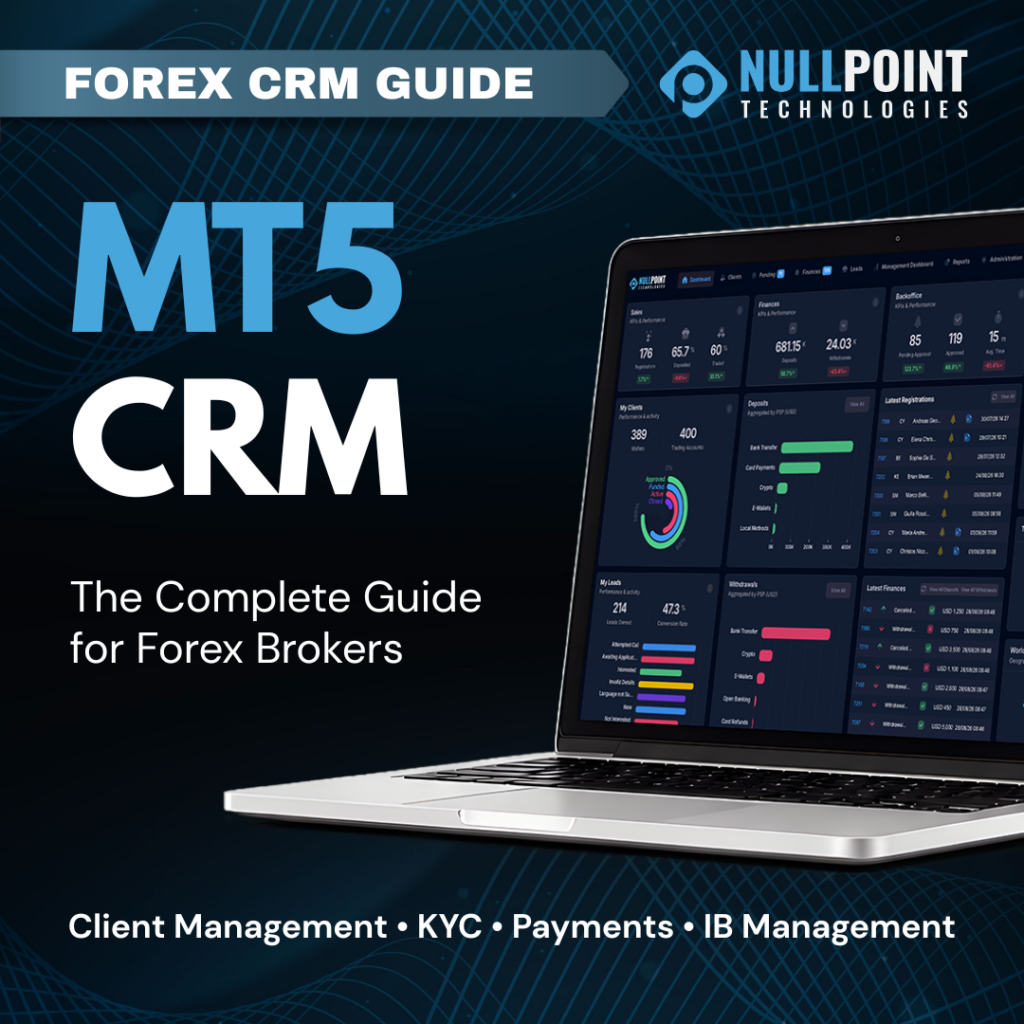
The platform connects client management, onboarding, KYC, payments, trading accounts, sales, reporting and partner operations within a centralized brokerage environment, with support for MetaTrader 4, MetaTrader 5 and cTrader.
Rather than treating the CRM as an isolated sales database, Nullpoint approaches it as part of the wider brokerage technology stack. Trading platforms, payment providers, KYC services, communications technology and other third-party systems can form part of the connected environment.
For brokerages with partner-driven acquisition models, the ecosystem also includes dedicated IB & Partners Management, allowing multi-level partner networks, referrals, commissions, rebates and related operations to be managed alongside the wider client relationship.
The objective is straightforward: give brokerage teams a clearer operational environment while giving traders a connected Client Area through which they can manage their relationship with the broker.
Frequently Asked Questions About MT5 CRM
What is an MT5 CRM?
An MT5 CRM is customer relationship management software for brokerages using MetaTrader 5. It connects client management and operational workflows with the client’s trading-account relationship, helping brokers manage areas such as onboarding, KYC, payments, sales, Client Area activity and partner operations.
Is MetaTrader 5 a CRM?
No. MetaTrader 5 is a trading platform. A CRM performs a different role by managing the wider client and operational relationship surrounding the trading account.
Why does an MT5 broker need a CRM?
A brokerage needs to manage considerably more than trading activity. Registration, verification, payments, communications, partner attribution and client management all exist around the trading account. An MT5 CRM helps connect these processes within a centralized environment.
Can an MT5 CRM connect to payment providers?
Yes. Forex CRMs can integrate with payment service providers so that deposit and withdrawal workflows form part of the wider client environment. The specific providers available depend on the CRM and brokerage requirements.
Can an MT5 CRM integrate with KYC providers?
Yes. KYC and identity-verification services can be integrated with the CRM and Client Area to support registration, verification, document collection and related onboarding workflows.
Does an MT5 CRM support Introducing Brokers?
A purpose-built Forex CRM can include or connect with IB Management functionality. This can allow brokerages to manage referrals, multi-level partner structures, commissions, rebates and partner reporting alongside the underlying client relationships.
Can a CRM support MT4 and MT5 at the same time?
This depends on the provider. Nullpoint supports brokerage environments across MT4, MT5 and cTrader, allowing brokers to build their CRM around more than one trading platform where required.
What should I look for in the best MT5 CRM?
Brokers should evaluate integration depth, Client Area functionality, onboarding and KYC, payment integrations, IB Management, reporting, customization, scalability, multi-brand requirements and the provider’s implementation and support capabilities. The best solution depends on the brokerage’s operating model rather than the number of features advertised.
Choosing the Right MT5 CRM
An MT5 CRM sits at an important intersection within the brokerage technology stack. It connects the client relationship with many of the systems and processes surrounding MetaTrader 5.
That makes CRM selection a broader decision than choosing a sales platform or comparing feature lists.
Brokers should evaluate how the system supports the complete client lifecycle, how deeply it connects with the trading environment, how flexible its integration ecosystem is and whether the technology can accommodate the brokerage as its operational requirements evolve.
A strong MT5 CRM should reduce fragmentation rather than add another layer of it.
For brokerages evaluating their current CRM or planning a new technology environment, the most useful starting point is therefore not asking which platform has the most features. It is understanding which workflows matter most to the business and determining how effectively the CRM connects them.
Looking for an MT5 CRM built around your brokerage? Explore the Nullpoint Forex CRM & Client Area or contact our team to arrange a tailored live demo.