
How to Choose a Forex CRM Provider: A Complete Guide for Brokers
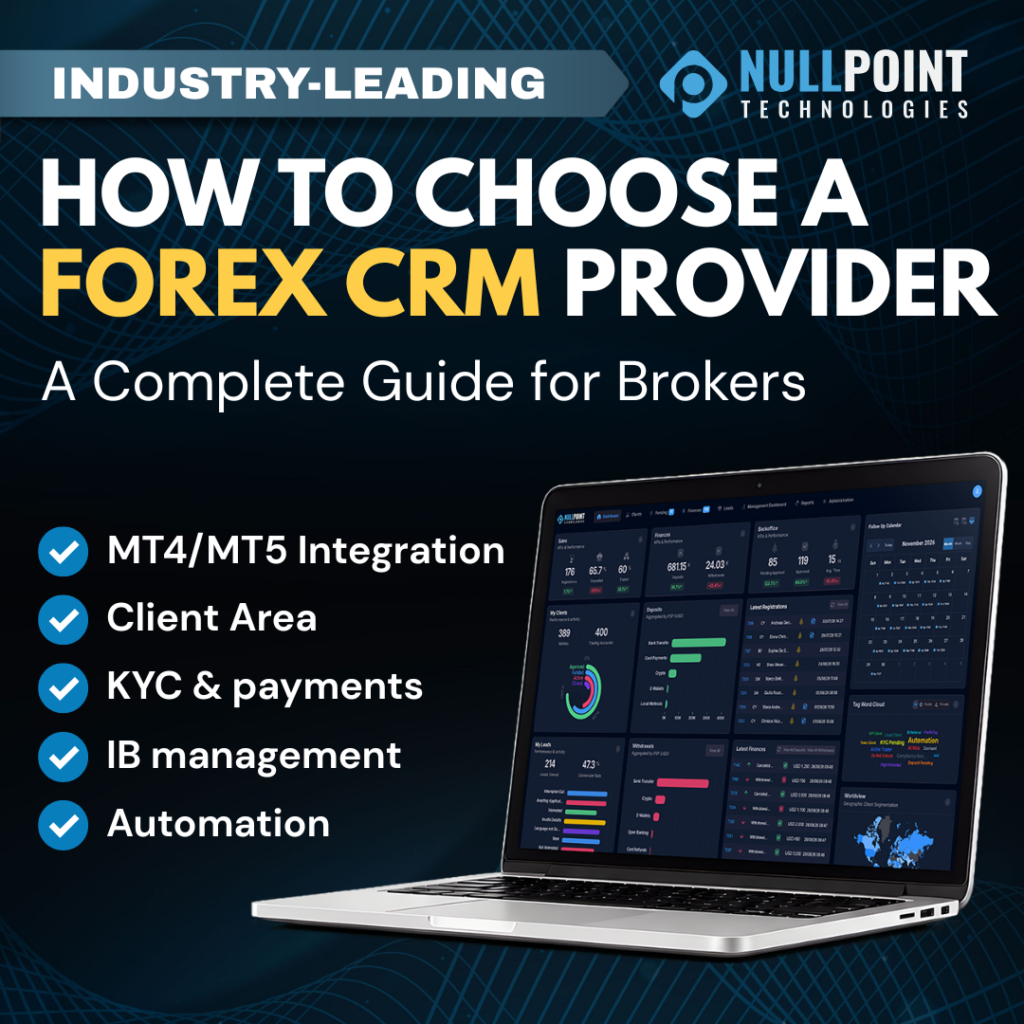
How to Choose a Forex CRM Provider: A Complete Guide for Brokers
Choosing a Forex CRM provider is one of the most consequential technology decisions a brokerage makes.
A Forex CRM is no longer simply a database where sales teams store leads and client information. For a modern Forex or CFD brokerage, the CRM sits at the center of client onboarding, KYC, trading accounts, deposits and withdrawals, sales operations, partner management, reporting and day-to-day back-office workflows.
The right platform can reduce manual work and connect previously fragmented operations. The wrong one can introduce additional processes, integration dependencies and operational bottlenecks.
That makes evaluating Forex CRM providers fundamentally different from selecting a conventional CRM.
This guide explains what brokers should evaluate before choosing a provider and which capabilities matter most when comparing Forex CRM solutions.
What Is a Forex CRM Provider?
A Forex CRM provider develops technology specifically designed to manage the relationship between a brokerage and its clients throughout the client lifecycle.
Unlike general-purpose CRM platforms, a Forex broker CRM needs to interact with the wider brokerage technology stack.
Depending on the brokerage, this can include:
- Trading platforms such as MetaTrader 4, MetaTrader 5 and cTrader
- KYC and identity-verification providers
- Payment service providers
- Client Area or Trader’s Room
- IB and affiliate systems
- Communication tools
- Reporting systems
- Brokerage back-office infrastructure
This distinction is important.
The CRM does not operate independently. It becomes an operational layer connecting multiple parts of the brokerage.
That means brokers should evaluate a Forex CRM provider based not only on what the interface looks like, but on how effectively the platform fits into the brokerage’s entire technology and operational environment.
1. Start With the Client Lifecycle
One of the easiest ways to evaluate a Forex CRM is to map the complete journey of a client.
Consider what happens from the moment a prospect registers.
The client may need to:
Register → Complete KYC → Open a trading account → Fund the account → Start trading → Request withdrawals → Receive communications → Interact with support
Meanwhile, different brokerage departments need visibility and control over that journey.
Sales teams need to understand lead activity. Compliance teams need access to verification information. Back-office teams need to manage financial requests. Management needs reporting, while the client expects all of this to happen through a consistent experience.
A strong Forex CRM should therefore connect these processes rather than creating separate operational silos.
When evaluating providers, ask:
How much of our client lifecycle can actually be managed from this system?
That question is considerably more useful than simply comparing feature lists.
2. Evaluate the Client Area as Part of the CRM
The administrative CRM is only one side of the platform.
For traders, the Client Area is often the primary interface with the brokerage. It can be where clients manage their profiles, complete verification, access trading accounts, make deposits and withdrawals and interact with other brokerage services.
The quality of the Client Area therefore directly affects the client experience.
When comparing Forex CRM providers, brokers should evaluate the CRM and Client Area together.
Look at:
- Registration experience
- Account management
- KYC flow
- Deposits and withdrawals
- Trading-account creation
- Internal transfers
- Responsive/mobile experience
- Branding and customization
- Localization
- Overall usability
A powerful back office paired with a poor client experience is still a weak overall solution.
3. Check Trading Platform Integration
Trading platform connectivity is one of the fundamental differences between a generic CRM and a CRM for Forex brokers.
For MetaTrader brokerages in particular, the CRM may need to interact with MT4 or MT5 for operations involving trading accounts and client information.
The exact requirements will differ between brokerages.
Before selecting a provider, establish which platforms the brokerage operates today and which it may introduce later. This could include MT4, MT5 and cTrader.
Then determine exactly what the CRM can do with each platform.
Don’t settle for a checkbox saying:
MT5 supported.
Ask what “supported” actually means.
Can accounts be created? Can relevant trading-account information be synchronized? Can leverage or account settings be managed? Can different trading environments be supported? How is data exchanged between the CRM and trading platform? What happens if the brokerage adds another trading server?
The depth of the integration matters more than the existence of an integration logo.
Brokers should understand how their Forex CRM integrations work and, where deeper connectivity is required, how technologies such as an MT4 API or MT5 API can connect the trading platform with the CRM, Client Area and other brokerage applications.
This level of connectivity matters because the CRM ultimately needs to work with the trading infrastructure rather than exist alongside it as another disconnected system. Nullpoint’s own CRM, for example, supports MT4, MT5 and cTrader connectivity as part of the broader brokerage environment.
4. Examine KYC and Onboarding Workflows
Client onboarding is another critical area.
A brokerage may acquire large numbers of leads, but poor onboarding processes can create unnecessary friction before those prospects become active clients.
A Forex CRM should allow the brokerage to structure onboarding according to its operational requirements.
This includes areas such as registration, client information, document collection, identity verification, KYC workflows, account approval, trading-account creation and client status management.
The CRM should also work effectively with the brokerage’s chosen KYC technology.
When evaluating a provider, brokers should therefore ask which KYC integrations are available and how verification results are incorporated into the back office.
This is another reason to examine the provider’s wider integration ecosystem rather than evaluating the CRM interface in isolation.
5. Look Closely at Payments
Payments are another area where Forex CRM requirements become highly specialized.
Brokerages often operate with multiple payment methods, currencies and payment service providers.
The CRM and Client Area need to make those processes manageable for both the trader and the brokerage.
Evaluate how the system handles deposits, withdrawals, payment provider integrations, transaction statuses, approval workflows, back-office visibility and reporting.
The important question is not simply how many payment providers appear on an integration page.
What matters is whether the payment infrastructure required by your brokerage can be incorporated effectively into the operational workflow.
A well-connected Forex CRM integration environment should allow payment providers and other third-party technologies to operate as part of the wider brokerage ecosystem rather than as isolated systems.
6. Don’t Treat IB Management as an Afterthought
For many Forex and CFD brokerages, Introducing Brokers are an important acquisition channel.
That makes IB & Partners Management a major consideration when selecting a Forex CRM provider.
A brokerage may need to manage multiple partner levels, client referrals, commission structures, rebates, partner performance, marketing materials, partner payments and sub-IB relationships.
These structures can become increasingly complex as a brokerage grows.
The CRM ecosystem should therefore allow partner operations to scale without creating excessive administrative work.
For brokerages operating more complex partner structures, a dedicated multi-level Forex IB management system can provide the infrastructure required to manage hierarchical IB networks, commissions, rebates and partner operations at scale. Nullpoint’s IB platform, for example, is specifically built around multi-level partner networks and brokerage partner automation.
This is particularly important for brokerages operating across several markets or relying heavily on partner acquisition.
7. Evaluate Automation, Not Just Features
Two Forex CRM platforms can contain similar feature lists while requiring very different amounts of manual work.
That’s why brokers should evaluate workflows, not just features.
Ask the provider to demonstrate actual operational scenarios.
What happens after a new client registers? What happens when KYC is approved? What happens when a deposit is received? What happens when a withdrawal requires review? What happens when a client needs to be assigned to a particular team? What happens when an IB earns a commission?
A good demonstration should show the entire process rather than jumping between isolated screens.
The objective is simple: reduce unnecessary manual intervention while maintaining operational control.
This is also where the difference between having many features and having a genuinely connected brokerage platform becomes apparent.
8. Consider Multi-Brand and Multi-Entity Requirements
A CRM that works perfectly for a small brokerage may become restrictive as the organization expands.
This becomes particularly important for brokerages operating multiple brands, multiple websites, multiple jurisdictions, different sales teams, different payment environments or multiple trading platforms and servers.
If expansion is part of the business plan, discuss those requirements before choosing the CRM.
These requirements should be considered at architecture level rather than after expansion has already taken place. A multi-brand Forex CRM should allow the brokerage to manage distinct brands and operational environments without unnecessarily fragmenting client and back-office infrastructure.
Migrating core brokerage infrastructure later can be significantly more complicated than selecting a scalable architecture from the beginning.
9. Understand Customization Versus Configuration
Almost every Forex CRM provider advertises customization.
But customization can mean very different things.
One platform may allow administrators to configure existing functionality. Another provider may be capable of developing functionality specifically around a brokerage’s requirements.
Neither approach is automatically better.
The important question is how much flexibility the brokerage actually requires.
Ask what administrators can configure themselves, what requires provider involvement, what requires custom development, how custom requirements are priced and how customized components are maintained after updates.
These questions can reveal significant differences between apparently similar providers.
Integration flexibility should also form part of this assessment. A brokerage may eventually need to connect additional payment providers, KYC services, communications platforms or trading infrastructure, making the provider’s approach to Forex CRM integrations an important part of long-term scalability.
10. Evaluate the Provider, Not Only the Product
Forex CRM selection is also a technology-partner decision.
The brokerage may rely on the provider for implementation, integrations, troubleshooting, maintenance and future development.
Consequently, due diligence should extend beyond the software demonstration.
Evaluate the provider’s industry specialization. Does the company primarily understand brokerage technology, or is Forex simply another vertical?
Consider its technical capability. Can the provider handle integrations and custom development when required?
Understand the implementation process. What information and access are required before deployment?
Examine how technical support and escalation are handled, whether the platform is actively evolving and whether the provider can continue supporting the brokerage as its technology stack becomes more complex.
A polished interface matters. The organization behind it matters just as much.
Questions to Ask Every Forex CRM Provider
Before making a decision, brokers should ask prospective providers a consistent set of questions:
- Which trading platforms do you support?
- What functionality is available through each integration?
- Which KYC providers can be connected?
- Which payment providers are currently supported?
- How are deposits and withdrawals managed?
- Is the Client Area included?
- How customizable is the Client Area?
- Does the platform include IB and partner management?
- Can it support multi-level IB structures?
- Can the CRM support multiple brands?
- What can administrators configure without development?
- How are custom integrations handled?
- What reporting capabilities are available?
- How is existing client data migrated?
- What does implementation require from the brokerage?
- How is ongoing technical support handled?
- How does the platform scale as client numbers and trading infrastructure grow?
The answers provide a much more useful comparison than simply counting features.
What Should a Modern Forex CRM Include?
At a minimum, brokers evaluating modern Forex CRM software should expect the platform to address four major areas.
Client Management
The brokerage needs a centralized view of its clients, activity and operational history.
Client Area
Traders need a secure and intuitive environment for managing their relationship with the brokerage. The Forex CRM & Client Area should work as a connected environment rather than two unrelated systems.
Integrations
The CRM needs to interact with the trading, payments, KYC and communications infrastructure surrounding it. Brokers should evaluate the available Forex CRM integrations as well as the provider’s ability to develop additional connectivity as their technology stack evolves.
For MetaTrader brokers, this can extend to technologies such as an MT4 Web API or MT5 Web API when deeper connectivity with external brokerage applications is required.
Partner Management
Where IBs and affiliates form part of the acquisition strategy, Forex IB and partner management should connect naturally with the wider client-management environment.
Beyond these fundamentals, the appropriate feature set depends on the brokerage’s business model.
Choosing the Right Forex CRM Provider
There is no universal answer to which Forex CRM provider is right for every brokerage.
A startup operating a single MT5 environment has different requirements from an established multi-brand broker operating across several jurisdictions.
The objective should therefore not be to find the CRM with the longest feature list.
It should be to find the provider whose technology most closely matches the brokerage’s operational model, technology stack, client journey, partner structure and future growth plans.
The best evaluation process starts by documenting those requirements and then asking each provider to demonstrate how the platform would handle them in practice.
Nullpoint Technologies as a Forex CRM Provider
Nullpoint Technologies provides Forex CRM & Client Area technology built specifically for Forex and CFD brokerages.
The platform brings together client management, onboarding, KYC, payments, trading-account operations and brokerage workflows within a unified environment. Nullpoint’s current platform also connects CRM operations with MT4, MT5 and cTrader and includes functionality across KYC, payments, sales, partner management and reporting.
The wider Nullpoint technology ecosystem also includes Forex IB & Partners Management, MT4 & MT5 tools and plugins, MT4 & MT5 brokerage services and brokerage integrations, allowing brokers to address multiple operational requirements through a technology provider focused specifically on the brokerage industry.
For brokerages evaluating a new Forex CRM provider or considering replacing an existing platform, the most effective next step is to evaluate the system against the brokerage’s actual operational requirements rather than a generic feature checklist.
See the Nullpoint Forex CRM & Client Area →
FAQ
What is a Forex CRM provider?
A Forex CRM provider is a technology company that develops customer relationship management software specifically for Forex and CFD brokerages. Unlike generic CRM software, a Forex CRM typically needs to work with trading platforms, KYC systems, payment providers, Client Areas and brokerage-specific operational workflows.
What should brokers look for in a Forex CRM provider?
Brokers should evaluate trading-platform connectivity, Client Area capabilities, KYC and payment integrations, IB management, automation, reporting, customization, scalability, implementation and ongoing technical support.
Is a Forex CRM different from a normal CRM?
Yes. Generic CRM platforms primarily focus on sales and customer relationship management. Forex CRM software must additionally accommodate brokerage-specific processes such as trading accounts, KYC, deposits and withdrawals, Client Areas and IB networks.
Does a Forex CRM work with MT5?
Forex CRM platforms can integrate with MetaTrader 5, but the depth of the integration varies between providers. Brokers should evaluate exactly which MT5 account-management and synchronization functions are supported rather than relying only on an “MT5 integration” claim.
For brokers that require deeper connectivity between MetaTrader 5 and external brokerage applications, an MT5 API can provide an additional integration layer between the trading platform, CRM, Client Area and other systems.
Can a Forex CRM manage IBs?
A Forex CRM ecosystem can include IB and partner-management functionality for referrals, partner structures, commissions, rebates and performance monitoring. Brokerages with significant partner networks should evaluate this functionality as a core requirement rather than an optional extra.
This version gives the article a much stronger internal-link architecture while preserving its original informational intent. In particular, it now feeds authority toward the CRM commercial page, Integrations, IB Management, MT4/MT5 APIs, MetaSuite and supporting CRM content instead of leaving the guide relatively isolated.