What Does an MT4/MT5 Administrator Do? A Guide for Forex Brokers
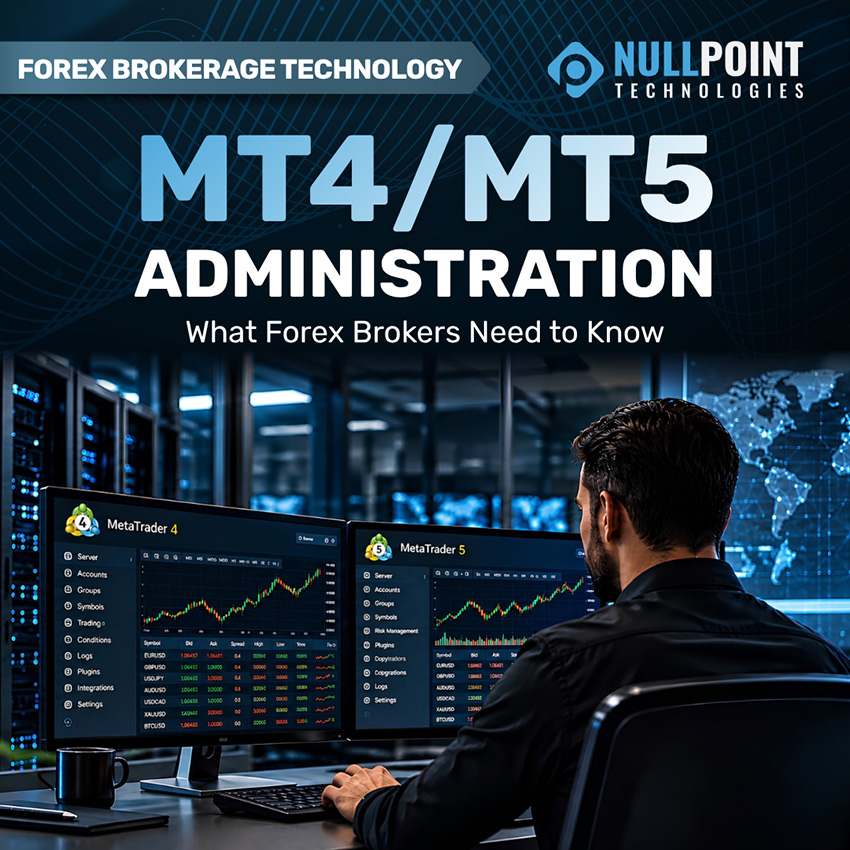
MetaTrader may be what traders see when they log in to place a trade, but behind every MT4 or MT5 environment is a significant amount of technical administration that clients will never see.
Trading servers need to remain available. Symbols and groups need to be configured correctly. Trading conditions have to reflect the brokerage’s requirements. Infrastructure needs to be monitored, plugins maintained, access controlled and technical issues investigated when something does not behave as expected.
This is where the MT4/MT5 Administrator comes in.
For a Forex or CFD broker, MetaTrader administration is not simply IT support. The administrator sits close to the operational core of the brokerage and is responsible for maintaining the environment on which trading activity depends.
Understanding that role is particularly important for growing brokers deciding whether to build an internal MetaTrader team or use an external MT4 & MT5 server management and administration provider.
What Is an MT4/MT5 Administrator?
An MT4/MT5 Administrator is a technical specialist responsible for the configuration, maintenance, monitoring and day-to-day technical operation of a brokerage’s MetaTrader environment.
The exact responsibilities vary depending on the size and structure of the brokerage. In a smaller operation, one administrator may handle a broad range of platform and infrastructure responsibilities. Larger brokers may distribute these responsibilities across several administrators, infrastructure engineers, developers, dealers and risk teams.
The important distinction is that the administrator is responsible for keeping the technical environment correctly configured and operational.
MetaQuotes itself distinguishes between the MetaTrader Administrator, Manager and Dealer roles. The administrator focuses on platform administration, while other roles are designed around client management and trading operations.
This distinction matters because an MT4/MT5 Administrator should not simply be viewed as somebody who creates accounts or changes settings when requested. The role involves understanding how changes at platform level can affect traders and the brokerage as a whole.
Managing the MetaTrader Server Environment
One of the administrator’s fundamental responsibilities is maintaining the MetaTrader server environment.
A brokerage depends on its trading infrastructure being continuously available. Administrators therefore monitor the environment, investigate technical issues, perform ongoing maintenance and coordinate changes or upgrades when required.
The job becomes increasingly important as the infrastructure becomes more complex. A brokerage may operate multiple servers, access points, integrations, plugins and external connections, potentially across different locations.
MT5, for example, uses a distributed architecture in which different platform functions can operate across multiple servers. MetaQuotes also provides access-server infrastructure intended to improve connectivity between traders and the trading environment.
The administrator needs to understand the architecture behind the brokerage’s particular deployment rather than simply the interface used to configure it.
For brokers that do not maintain this expertise internally, these responsibilities can form part of an outsourced MetaTrader server management service.
Configuring Symbols and Trading Conditions
A large part of MetaTrader administration involves controlling how financial instruments behave within the trading environment.
A symbol is much more than the name displayed to the trader.
Depending on the platform and brokerage configuration, parameters can determine contract specifications, trading sessions, margin requirements, swaps, commissions and other trading conditions. MetaQuotes’ current MT5 broker documentation specifically describes broker-level control over margin requirements, contract specifications, credit limits, swaps, trading sessions, spreads, markups and commissions.
That means configuration errors can have consequences well beyond how something appears in the terminal.
If a trading session is configured incorrectly, clients may be able to trade when they should not—or may be prevented from trading when the market should be available. An incorrect contract specification can affect calculations. A mistake in swaps or margin configuration can directly affect clients and the brokerage.
Administrators therefore need both technical platform knowledge and an understanding of the operational implications of the settings they manage.
Managing Groups and Account Configurations
Client groups are another important part of MetaTrader administration.
Brokerages rarely offer identical conditions to every client. Different account types, client segments or commercial arrangements may require different configurations.
Groups can be used to organize accounts and apply the appropriate platform settings to them. As the brokerage grows, the number of configurations that need to be maintained can increase significantly.
An administrator needs to ensure that accounts are assigned correctly and that changes to group-level settings are intentional, tested and properly controlled.
This is also where MetaTrader administration begins to intersect with the brokerage’s wider technology.
A client may choose an account type through a Forex CRM & Client Area, after which the appropriate trading account needs to be created within MetaTrader with the correct configuration.
In a connected environment, APIs can automate much of that routine workflow. The administrator, however, remains responsible for ensuring that the underlying MetaTrader configuration the automation relies upon is correct.
Monitoring Platform Health and Troubleshooting Problems
When something goes wrong in a trading environment, determining the cause is not always straightforward.
A reported problem may originate from MetaTrader itself, the server environment, network connectivity, an access point, a plugin, an integration or another system communicating with the platform.
An MT4/MT5 Administrator needs to investigate rather than assume.
That can involve reviewing logs, examining platform behaviour, checking recent configuration changes, assessing infrastructure status and determining whether the issue originates internally or from an external component.
Good troubleshooting is therefore partly technical knowledge and partly process.
The administrator needs to understand how the different components of the environment interact so that a problem can be isolated efficiently.
This becomes especially important in live trading environments, where a seemingly small technical issue can affect many clients simultaneously.
Managing Plugins and Platform Extensions
Most established brokerages extend MetaTrader beyond its standard functionality.
Plugins and tools can be used to automate fees, manage swaps, apply risk controls, change trading conditions, connect external systems or address brokerage-specific operational requirements.
Those extensions introduce another layer that needs to be managed.
Administrators may be involved in deploying plugins, configuring them, monitoring their operation, coordinating upgrades and investigating unexpected behaviour.
They also need to understand that a platform extension can affect live trading operations.
For this reason, introducing new functionality should involve appropriate testing and change management rather than simply installing software directly into a production environment.
Nullpoint’s MT4 & MT5 tools and plugins are examples of this type of brokerage-side platform extension, covering areas such as operational automation, trading controls and risk management.
Supporting APIs and Brokerage Integrations
MetaTrader rarely operates in isolation anymore.
Trading platforms increasingly need to communicate with CRM systems, Client Areas, payment infrastructure, reporting tools and internally developed applications.
MetaTrader provides APIs for extending and integrating the platform, and MetaQuotes explicitly identifies CRM and proprietary-system integration as part of MT5’s broker-side architecture.
The administrator may not personally develop every integration, but they need to understand how those connections interact with the trading environment.
Consider something as routine as creating a trading account.
A trader requests an account through the Client Area. The CRM determines the appropriate configuration. An API communicates with MetaTrader. The trading account is created and the result is returned to the client-facing system.
The process may be automated, but it still depends on a correctly configured trading environment.
For brokers building this type of infrastructure, the MT4 Web API and MT5 Web API can provide the integration layer between MetaTrader and external brokerage applications.
Managing Access and Permissions
A brokerage trading environment is used by more than administrators.
Dealers, risk teams, operations employees, finance staff and other users may require different levels of platform access.
Those permissions should not be treated casually.
MetaTrader 5 provides granular role-based access controls for different staff functions, and its architecture is designed to allow brokers to separate responsibilities across administrators, dealers, accountants, risk managers and other employees.
Part of good platform administration is therefore ensuring that users have the access required to perform their responsibilities without unnecessarily expanding permissions.
This becomes increasingly important as the organization grows and more employees interact with the trading infrastructure.
Maintenance, Updates and Change Management
Trading infrastructure does not remain static.
Platforms are updated. New symbols are introduced. Account structures change. Plugins receive new versions. Integrations evolve. Infrastructure is expanded and business requirements change.
Each modification introduces some degree of operational risk.
An administrator therefore needs to manage change carefully.
Before modifying a live environment, the impact of the change should be understood. Appropriate backups or recovery procedures should exist where relevant. New functionality should be tested before production deployment, and important changes should be documented so that teams know what was modified and why.
MetaQuotes notes that MT5 platform databases support backup and recovery procedures, while its server architecture is designed around resilience and distributed operation.
Technology provides the capability, but good administration determines how safely that capability is used.
MT4/MT5 Administrator vs Developer: What Is the Difference?
The roles overlap, but they are not the same.
An MT4/MT5 Administrator primarily manages and maintains the trading environment. A developer creates or modifies software that extends that environment.
For example, configuring an existing plugin would normally fall within administration. Building a new plugin to implement a brokerage-specific requirement is development.
Similarly, an administrator may configure and supervise an API integration, while developers build the applications and logic communicating through that API.
The distinction becomes particularly useful when brokers evaluate technology providers.
Some requirements can be solved through configuration. Others require software development. A technical partner capable of handling both can determine which approach is appropriate rather than treating every requirement as a development project.
Nullpoint combines MT4 & MT5 administration with custom MetaTrader development, APIs and platform extensions for this reason.
What Does an MT4/MT5 Administrator Do Every Day?
There is no universal daily checklist because the role depends heavily on the brokerage’s infrastructure and current activity.
On a normal day, an administrator may review the health of the trading environment, investigate alerts or reported issues, make approved configuration changes, manage symbols or groups, review logs, support other internal teams and coordinate work involving plugins or integrations.
Other days may involve a platform upgrade, infrastructure change, rollout of a new account type, deployment of a plugin or investigation of an unexpected production issue.
Much of the administrator’s value comes from preventing problems rather than reacting to them.
When the environment is correctly maintained, traders and other brokerage employees may barely notice the work being performed behind it.
That is usually a good sign.
Should a Broker Hire an Internal Administrator or Outsource MT4/MT5 Administration?
Both models can work.
Large brokerages with complex infrastructure and continuous technical requirements may benefit from maintaining dedicated internal MetaTrader expertise. Direct access to administrators can be valuable when platform changes occur frequently or the brokerage operates a particularly complex environment.
Outsourcing can make more sense when a broker needs specialist expertise without maintaining a complete MetaTrader administration function internally.
There is also a hybrid model. A brokerage can retain internal technical or operations staff while relying on an external provider for specialized administration, infrastructure work, troubleshooting or development.
The decision should therefore be based on the complexity of the environment, internal expertise, operational requirements and the level of support the brokerage needs—not simply the number of trading accounts it operates.
Why MetaTrader Administration Matters More as a Brokerage Scales
Technical complexity tends to increase faster than it first appears.
A brokerage starts with a trading platform and a relatively simple configuration. Over time, it introduces additional account types, symbols, payment providers, CRM workflows, IB structures, plugins, APIs and other integrations.
Each component creates another dependency.
The MetaTrader Administrator increasingly sits at the point where many of those dependencies meet.
This is why good administration should not be viewed purely as maintenance. It contributes to operational stability, controlled change and the ability of a brokerage to expand its technology without creating unnecessary technical risk.
The objective is simple: traders should be able to use the platform without having to think about the infrastructure behind it.
Achieving that consistently requires considerably more work than the client terminal reveals.
MT4 & MT5 Administration With Nullpoint
Nullpoint provides MT4 & MT5 server management and administration for Forex and CFD brokers that require experienced technical support behind their MetaTrader infrastructure.
Our services cover ongoing administration, platform configuration, hosting and infrastructure support, troubleshooting and custom development, while our wider brokerage technology expertise extends across Forex CRM, integrations, APIs and MT4 & MT5 tools and plugins.
Whether your brokerage needs ongoing MetaTrader administration or specialist support alongside an existing internal team, the objective is the same: maintain a reliable trading environment while giving your business the technical flexibility to evolve.
Talk to our MT4 & MT5 team about your current infrastructure and administration requirements.