MT4 API for Forex Brokers: What It Is and What You Can Build With It
MetaTrader 4 remains at the heart of the technology infrastructure of many established Forex brokerages. But while MT4 may power the trading environment, the modern brokerage around it has evolved considerably.
Today, brokers operate Forex CRM platforms, Client Areas, payment systems, KYC services, back-office applications and proprietary technology alongside their trading platforms. For these systems to work efficiently, they need a reliable way to communicate with the MT4 environment.
This is where an MT4 API becomes important.
An MT4 API allows brokers to connect MetaTrader 4 with external systems and automate operations that would otherwise require manual intervention. Trading accounts can be created from a Client Area, balance information can be retrieved by a CRM, funding workflows can interact with MT4, and proprietary applications can communicate directly with the brokerage’s trading infrastructure.
For established MT4 brokers, this means the platform does not need to operate as an isolated system. With the right API infrastructure, MT4 can become part of a much broader and more automated brokerage technology ecosystem.
What Is an MT4 API?
An MT4 API is an application programming interface that enables external software to communicate with a MetaTrader 4 environment.
The API effectively creates a controlled connection between MT4 and another application. Instead of brokerage staff having to perform every operation manually within the trading platform, authorized systems can send requests and retrieve information programmatically.
Consider a client opening another trading account through a broker’s Client Area. Without integration, that request may need to pass through an internal operational process before the corresponding account is created within MT4.
With an API-connected environment, the Client Area can initiate the required operation automatically.
The same principle can be applied across CRM, funding, account management and other brokerage workflows.
What Is an MT4 Web API?
An MT4 Web API provides a web-based interface through which external applications can communicate with the MT4 server.
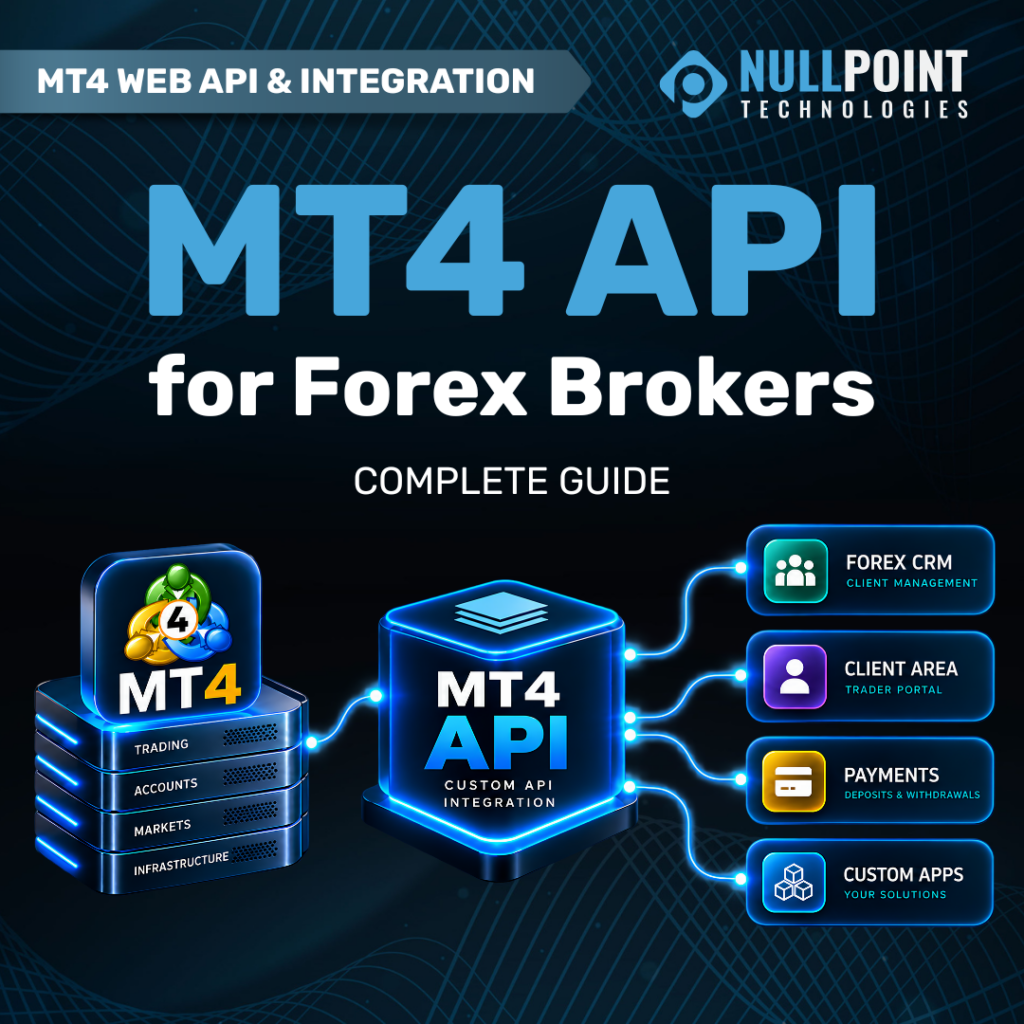
This makes it possible to connect MT4 with technologies such as a Forex CRM and Client Area, payment infrastructure, back-office software and custom applications.
Nullpoint’s MT4 Web API is specifically designed to enable communication between an MT4 server and external systems. Its supported functionality includes account creation and editing, balance operations, password resets, balance and equity retrieval, and connectivity with third-party or proprietary applications.
The API therefore acts as an integration layer between the trading platform and the technology surrounding it.
What Can Forex Brokers Do With an MT4 API?
The value of API connectivity becomes clearer when looking at the actual operations a brokerage can build around it.
Rather than treating MT4 as a standalone platform, brokers can make trading-account functionality available within the systems already used by clients and operational teams.
Create and Manage MT4 Trading Accounts
Account administration is one of the clearest applications of an MT4 API.
A trader requesting an additional account through a Client Area can trigger an automated workflow that creates the corresponding trading account in MT4. Existing account information can also be updated through an authorized external system.
Nullpoint’s MT4 Web API supports both account creation and account editing, allowing these operations to be initiated by connected applications.
This becomes increasingly valuable as client volumes grow. Routine account operations can be automated while brokerage teams concentrate on requests that actually require human attention.
Connect MT4 With a Forex CRM
A major use case is MT4 CRM integration.
A modern Forex CRM can sit at the center of the client relationship, bringing together onboarding, KYC, payments, sales, retention, trading accounts and back-office operations.
Connecting MT4 to the CRM allows trading-account information and operations to become part of those workflows.
Sales and operational teams can work from a more complete client picture rather than constantly moving between disconnected systems. Actions originating within the CRM can also interact with MT4 through the API where appropriate.
For established brokerages with significant MT4 infrastructure, this provides a way to modernize the surrounding client and operational experience without separating it from the underlying trading platform.
Connect MT4 With a Client Area
The Forex CRM & Client Area is another natural destination for MT4 API integration.
Clients increasingly expect routine account management to be available through a broker’s own digital environment.
An integrated Client Area can allow traders to request or perform supported account operations while the API handles communication with MT4 behind the scenes.
This can include trading-account creation, account information, password-related workflows and financial information such as balance and equity.
The trader remains within the brokerage’s branded Client Area while the MT4 Web API provides the connection to the underlying trading infrastructure.
Integrate Deposits and Withdrawals With MT4
Funding is one of the most operationally important areas to connect.
A brokerage may have a Client Area, CRM, cashier and multiple payment providers operating around MT4. When these systems are disconnected, funding workflows can become unnecessarily dependent on manual processes or separate middleware.
An MT4 API can allow authorized applications to trigger the relevant balance operations as part of a broader funding workflow.
Nullpoint’s MT4 Web API supports deposit and withdrawal balance operations through the API.
Combined with the brokerage’s wider Forex CRM integrations, this allows payment infrastructure, client-facing systems and the trading platform to form part of a more connected process.
Retrieve MT4 Balance and Equity Data
External brokerage systems often need information from trading accounts without requiring a user to access MT4 directly.
A CRM may need trading information to provide a more complete client overview. A Client Area may need to display account information to the trader. An internal application may require account data for monitoring or operational workflows.
Nullpoint’s MT4 Web API supports balance and equity checks, making this information available to connected CRMs, Client Areas and monitoring applications.
This is important because it allows relevant MT4 information to become useful throughout the brokerage rather than remaining confined to the trading platform.
Automate MT4 Password Workflows
Password administration is another example of a repetitive operation that can be incorporated into an automated client journey.
Instead of requiring routine password requests to be processed manually, a connected Client Area or other authorized application can communicate with MT4 through the API.
The Nullpoint MT4 Web API supports secure trading-account password resets through connected systems.
Individually, workflows like this may appear relatively small. Across thousands of clients and repeated operational requests, however, removing unnecessary manual intervention can make a meaningful difference to brokerage operations.
Build Custom Applications Around MT4
An MT4 API is not only useful for connecting an existing CRM.
It can also provide the foundation for brokers developing their own technology.
A brokerage may want to build a proprietary Client Area, internal account-management interface, back-office application, monitoring system or another tool designed specifically around its business.
Nullpoint’s MT4 Web API can connect with third-party and in-house applications that support API communication.
This gives brokers considerably more flexibility in how they build their technology ecosystem around MT4.
Instead of being limited to a predefined combination of products, API connectivity allows the brokerage to determine how its own systems interact with the trading platform.
Modernizing an Established MT4 Brokerage
This is where the business case for an MT4 API becomes particularly interesting.
A brokerage does not necessarily need to replace its established MT4 infrastructure to modernize the technology surrounding it.
The trading platform can remain at the core while newer CRM systems, Client Areas, payment infrastructure and proprietary applications are connected around it.
An API effectively creates the integration layer required to make that possible.
For established MT4 brokers, this can provide a practical path toward greater automation and a more modern client experience while retaining the trading infrastructure on which the business already operates.
MT4 API and Brokerage Automation
The broader objective is not simply integration. It is brokerage automation.
As a brokerage grows, routine operational activity grows with it. More clients mean more account requests, funding activity, password requests, account checks and data that needs to move between systems.
Without integration, the workload associated with these operations can scale alongside the brokerage.
With an API-connected architecture, many predictable workflows can instead move automatically between systems.
A client performs an action through the Client Area, the CRM or back office processes the workflow, the required MT4 operation takes place through the API, and the relevant information is returned to the connected systems.
Human teams can then focus on exceptions, decisions and higher-value work rather than repeatedly transferring information between platforms.
Security and MT4 API Access
Connecting external systems to trading infrastructure requires careful control.
API integrations can potentially interact with sensitive client, account and financial operations, so authentication and access management need to form part of the architecture from the beginning.
Nullpoint’s MT4 Web API uses authentication and access controls for API calls to protect sensitive information and operations.
Brokers should also determine which systems need access, what each application should be permitted to do and how those interactions fit within the brokerage’s wider security and operational controls.
Can an MT4 API Scale With a Brokerage?
Scalability becomes particularly important when API connectivity supports frequently used functionality.
An integration handling occasional internal requests has very different demands from one sitting behind a Client Area used by a large active client base.
The architecture therefore needs to account for the expected operational volume.
Nullpoint describes its MT4 Web API architecture as designed for high-volume broker environments with large client bases.
For growing brokerages, this matters because integration infrastructure should support expansion rather than become another operational bottleneck.
MT4 API vs Manual MT4 Administration
An MT4 API does not replace platform administration.
There will continue to be configuration, supervision, troubleshooting and exceptional situations that require experienced administrators. What an API can change is the amount of repetitive work those teams need to perform.
Creating standard accounts, retrieving account information, processing predefined balance operations or handling routine password requests are predictable processes. Where appropriate controls exist, these are natural candidates for automation.
Brokers requiring broader assistance with their MetaTrader infrastructure can combine API connectivity with MT4 & MT5 server management, administration and development.
The goal is therefore not to remove human administration, but to use it where human expertise actually adds value.
MT4 API vs MT5 API
The fundamental integration objective is similar for both platforms: connect the trading environment with the systems surrounding the brokerage.
The appropriate API, however, depends on the trading infrastructure the brokerage operates.
MT4 brokers require connectivity designed for their MetaTrader 4 environment, while MT5 brokers require corresponding integration with MetaTrader 5.
Brokerages operating both platforms may therefore need both layers of connectivity so that their CRM, Client Area and other applications can provide a consistent experience across MT4 and MT5.
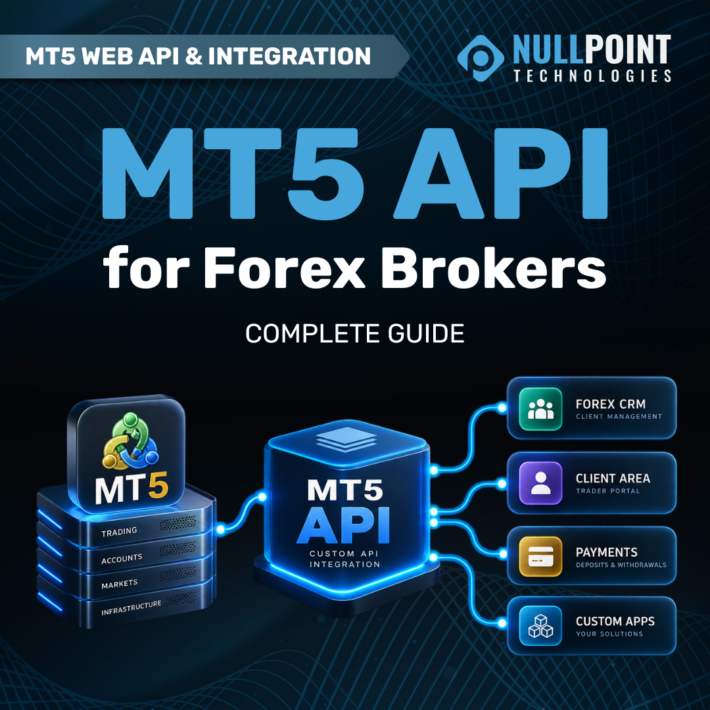
For brokers operating MetaTrader 5, we cover this separately in our MT5 API for Forex Brokers: Complete Guide.
This cross-link is important because it establishes the two articles as part of the same API knowledge cluster rather than two isolated posts.
Who Needs an MT4 Web API?
An MT4 Web API is particularly relevant to brokerages that want to retain MetaTrader 4 while modernizing the technology operating around it.
That can include brokers implementing a new Forex CRM, developing a branded Client Area, integrating payment workflows, building proprietary applications or reducing the amount of repetitive MT4 administration performed internally.
It is also relevant to established brokers whose technology stack has expanded over time and now requires a more structured integration layer between MT4 and the rest of the business.
Unlock More From Your MT4 Infrastructure
MetaTrader 4 may be the foundation of an established brokerage, but it does not need to define the limits of what the brokerage can build around it.
A well-designed MT4 API can connect the trading platform with CRM, Client Area, payments, back-office systems and proprietary applications, allowing information and operations to move more efficiently throughout the brokerage.
The result is an MT4 environment that remains at the core of the trading operation while becoming part of a more connected, automated and scalable technology ecosystem.
Nullpoint’s MT4 Web API provides connectivity for account creation and editing, deposits and withdrawals, password resets, balance and equity checks, and third-party or proprietary applications. It forms part of the NP MetaSuite range of MT4 & MT5 tools and plugins for Forex and CFD brokerages. Nullpoint Technologies
Build More Around Your MT4
If your brokerage needs to connect MetaTrader 4 with a CRM, Client Area, payments or proprietary technology, explore the Nullpoint MT4 Web API or contact the Nullpoint team to discuss your integration requirements.